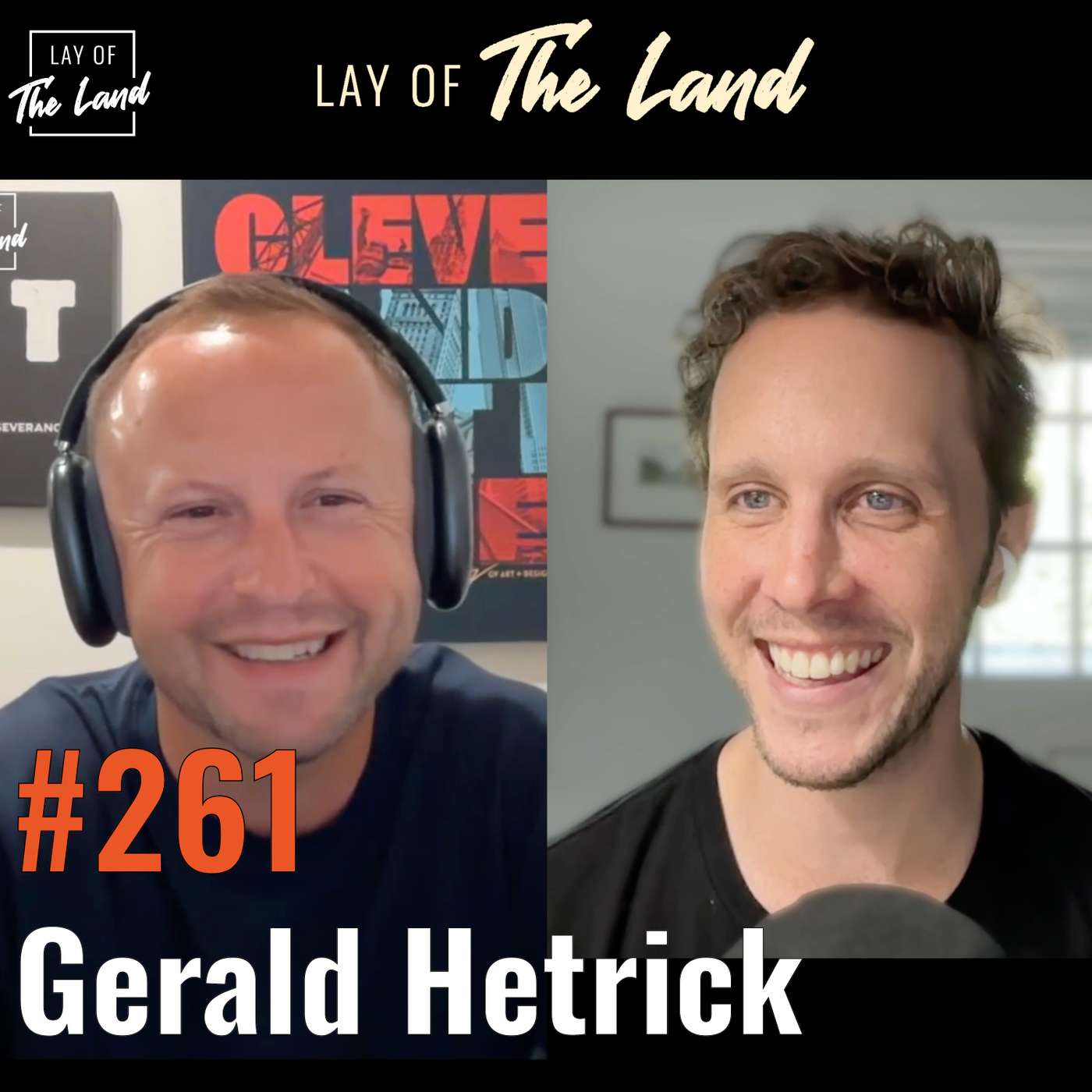
#261 Gerald Hetrick — Round III (CentSight)

 Apple Podcasts
 Spotify
 YouTube
 Castro
 RSS Feed
 Key Takeaways
- Gerald Hetrick returns for his third appearance on Lay of The Land to discuss his newest venture, CentSight, an AI financial analyst platform designed to help founders move from financial data to clarity.
- Reflecting on his entrepreneurial evolution, Gerald notes a shift from pursuing external success and recognition earlier in his career to prioritizing happiness and the pure joy of building from zero.
- Operating system coaching through EOS provided Gerald with a massive chest of experience and highlighted the critical difference between consensus and buy-in for effective leadership teams.
- Many small business owners struggle with financial fluency regarding the specific context of their unit economics and business models, often leading to decision-making paralysis.
- CentSight addresses financial clarity by keeping AI separate from raw math calculations and preventing the system from being talked into bad premises by the user.
- Building in Cleveland continues to be a core commitment for Gerald, who values the local community and believes strongly in building sustainable companies from the region.
Gerald Hetrick was one of the very first guests ever on Lay of The Land, back on episode 6, where we talked about his path through Vox Mobile, building Able, and what it took to grow a venture-backed software company from Cleveland. We then picked the story back up on episode 142 after Able’s acquisition by Bullhorn, exploring what an exit actually feels like, what Gerald had learned about company-building, and his work with Bezlio, Docket, and EOS.
Today, we continue that arc with Gerald’s newest chapter: CentSight, an AI financial analyst platform designed to help founders and small business owners move from financial data to financial clarity, having just closed a $1.5m seed round.
In our conversation, Gerald and I talk about what it feels like to build again after an exit, the evolution from pursuing success to pursuing happiness, what coaching other founders taught him about decision-making, the gap between financial fluency and financial honesty, how AI changes the speed and shape of company-building, and why Gerald is still committed to building from Cleveland. We also explore the tension between velocity and taste in the AI era, the importance of human judgment, and what it means to start from zero again with more experience, more humility, and still a lot of joy.
Gerald is a thoughtful repeat founder, a candid operator, and someone whose story has become something of a living chronology of entrepreneurship on this podcast. Please enjoy my third conversation with Gerald Hetrick.
00:00 Introduction and Gerald's entrepreneurial background
03:34 Gerald's journey from Vox Mobile to SenseSite
07:55 The joy of building something new from scratch
11:31 Lessons from coaching entrepreneurs and EOS
17:55 Introducing SenseSite and its origin story
22:55 The core problem SenseSite addresses for SMBs
27:46 Building trust with AI products
33:00 The future of AI in finance and decision-making
41:45 Reflections on product market fit and team building
48:50 Gerald's current focus and excitement about the future
55:46 Gerald's thoughts on building in Cleveland
57:55 Closing thoughts and how to connect with Gerald
-----
LINKS:
https://centsight.com/
https://linkedin.com/in/geraldhetrick
Episode 6: https://www.layoftheland.fm/6-gerald-hetrick-able/
Episode 142: https://www.layoftheland.fm/142-gerald-hetrick-part-ii-bezlio-eos/
-----
SPONSOR:
Cerity Partners
Cerity Partners, a full-service investment and wealth management firm serving high-net-worth individuals, entrepreneurs, and business owners, is proud to sponsor Lay of The Land. The firm has local roots in Cleveland and across Ohio, and like this podcast, Cerity Partners advisors specialize in serving the interests of local entrepreneurs and business leaders. The firm’s national presence means it can offer the resources and specialized knowledge of the largest institutions with the independence and service of a neighbor. The Cerity Partners Cleveland team understands the complexity that comes with wealth, and they adhere to fiduciary standards. Discover the financial lay of your land.
Learn more at https://ceritypartners.com/NPR or call 216-464-6266.
Roundstone Insurance
Roundstone Insurance is proud to sponsor Lay of The Land. Founder and CEO, Michael Schroeder, has committed full-year support for the podcast, recognizing its alignment with the company’s passion for entrepreneurship, innovation, and community leadership.Headquartered in Rocky River, Ohio, Roundstone was founded in 2005 with a vision to deliver better healthcare outcomes at a more affordable cost.
Over the past two decades, Roundstone has grown rapidly, creating nearly 200 jobs in Northeast Ohio. The company works closely with employers and benefits advisors to navigate the complexities of commercial health insurance and build custom plans that prioritize employee well-being over shareholder returns. By focusing on aligned incentives and better health outcomes, Roundstone is helping businesses save thousands in Per Employee Per Year healthcare costs. Roundstone Insurance — Built for entrepreneurs. Backed by innovation. Committed to Cleveland.
Learn more at https://roundstoneinsurance.com/
-----
Stay up to date by signing up for Lay of The Land's weekly newsletter — sign up here: https://layoftheland.ck.page/5f0c1e28fa
Connect with Jeffrey Stern on LinkedIn — https://www.linkedin.com/in/jeffreypstern/
Follow Lay of The Land on X @podlayoftheland
--
Stay up to date on all Cleveland Startup and Entrepreneurship stories by signing up for Lay of The Land's weekly newsletter — sign up here.
Frequently Asked Questions
Who is Gerald Hetrick?
Gerald Hetrick is a repeat founder and operator from Cleveland, known for building companies like Vox Mobile, Able (acquired by Bullhorn), Bezlio, Docket, and most recently, CentSight.
What is CentSight?
CentSight is an AI financial analyst platform designed to help founders and small business owners move from raw financial data to clear, actionable financial insights.
What was Able and what happened to it?
Able was a venture-backed software company built in Cleveland that was successfully acquired by Bullhorn, marking a major milestone in Gerald Hetrick's entrepreneurial journey.
How does CentSight handle financial calculations with AI?
CentSight keeps AI out of the raw math by using a sandbox, non-AI layer for calculations to ensure accuracy and trust, rather than relying on an LLM to compute figures.
Gerald Hetrick (Bezlio) [00:00:00]:
it can still feel like a successful ride. We still took a shot at something, still endeavored to build something that didn't exist, and hopefully it will be successful. As long as it's really genuine, authentic, and builds on the back of good decision-making, I think it will be— I'll think it's a success.
Jeffrey Stern [00:00:15]:
Welcome to the Lay of the Land podcast, where we are exploring what people are building in Cleveland and throughout Northeast Ohio. I am your host, Jeffrey Stern, and today I had the real pleasure of speaking with Gerald Hetrick for the 3rd time on the podcast. Gerald was one of the very first guests ever on Lay of the Land back on episode 6, where we talked about his path through Vox Mobile, building Able, and what it took to grow a venture-backed software company from Cleveland. We then picked the story back up on episode 142 after Able's acquisition by Bullhorn, exploring what an exit actually feels like, what Gerald has learned about company building, and his work with Beslio, Docket, and the Entrepreneurial Operating System. Today, we continue that arc with Gerald's newest chapter, Senseight, an AI financial analyst platform designed to help founders and small business owners move from financial data to financial clarity, having just closed a $1.5 million seed round. In our conversation, Gerald and I talk about what it feels like to build again after an exit, the evolution from pursuing success to pursuing happiness, what coaching other founders taught him about decision-making, the gap between financial fluency and financial honesty, how AI changes the speed and shape of company building, and why Gerald is still committed to building from Cleveland. We also explore the tension between velocity and taste in the AI era, the importance of human judgment, and what it means to start from zero again with more experience, more humility, and still a lot of joy. Gerald is a thoughtful repeat founder, a candid operator, and someone whose story has become something of a living chronology of entrepreneurship.
Jeffrey Stern [00:01:55]:
in Cleveland and on this podcast. So please enjoy my third conversation with Gerald Hetrick. Lay of the Land is brought to you and is proudly sponsored by Seriti Partners. As a wealth management firm, Seriti Partners shares Lay of the Land's same dedication to serving local business owners, and the Seriti Partners Cleveland team understands the challenges that entrepreneurs and founders face here in Cleveland, Northeast Ohio, and beyond. Wealth comes with complexity and increased demands on time and resources. it is easy to become overwhelmed. Serenity Partners clients benefit from a unified team of local specialists who coordinate across both business and personal needs. With Serenity Partners' commitment to transparency and putting clients' needs first, complexity can become clarity.
Jeffrey Stern [00:02:41]:
To learn more, please visit serenitypartners.com or call 216-464-6266 today. Serenity Partners, Proud to be recognized as one of the top financial advisory firms in the country. Well, Gerald, I just want to welcome you back to Lay of the Land for round 3.
Gerald Hetrick (Bezlio) [00:03:02]:
Incredible. I'm—
Jeffrey Stern [00:03:05]:
It's, you were one of the very first people to have ever come on the podcast and I think take a shot on, you know, this exploratory exercise at the time, back on I did look this up at episode 6, which is crazy to think about. And we talked in depth through your path to Vox Mobile, building Able, what it took to build a venture-backed software company from Cleveland. We, a few years later in the second conversation, kind of picked it up with EmployeeStream. Um, to the Able acquisition, to Bullhorn, what an exit kind of feels like, what you've learned about company building, the role of, uh, of operating systems and the work you were beginning to do with, with Beslio and Docket, um, and NEOS. And so now we get to continue that, that conversation today, which is, is pretty exciting and with a, a new chapter. Uh, so just, just grateful to have you back.
Gerald Hetrick (Bezlio) [00:04:09]:
Maybe I'll just— Thanks. Yeah, maybe anytime someone asks me for my bio, I'll just send them all these episodes and say, you can figure it out from there.
Jeffrey Stern [00:04:17]:
It's like a full chronology moment in time reflections. It's super cool actually.
Gerald Hetrick (Bezlio) [00:04:22]:
And I think actually, if I remember correctly, the first episode was during this heart of COVID I believe. And I think it was like everyone was learning how to do things virtually. And I think you weren't even certain if this was going to be a virtual podcast and we just happened, it had to be and it worked out great. But yeah, man, thanks for having me. Super, super excited to be back. Love chatting with you on and off the podcast setting and I'm looking forward to the conversation.
Jeffrey Stern [00:04:47]:
Me as well. Yeah, I'm glad. I was just thinking back then it was like right when everyone was getting into sourdough bread making.
Gerald Hetrick (Bezlio) [00:04:54]:
That's when this whole thing started. Yeah, that's exactly what it was, right? We were having drive-by birthday parties, sourdough bread making, and Zoom parties every night. That was the— and actually it's so funny because to this day, those things persist. Like, you know, my buddies and I sometimes will still be like, hey, let's jump on Zoom and just have a couple drinks and chat. And like, that never would've happened pre-COVID. So it's cool.
Jeffrey Stern [00:05:16]:
Yeah. So I'd love to, I think, just connect some of the dots here. And I think we'll take some time to reflect. We'll take some time to talk about what you're building now and why you're building it and more of the lessons you've learned. in your journey. But when you, when you look across Able, Beslio, Docket, EOS, now SenseSite, I mean, do you, do you feel there's a certain through line to, to this work at this point, or how have you even thought about that?
Gerald Hetrick (Bezlio) [00:05:53]:
Interesting. I think I have evolved from pursuit of success and success defined early in my career less about money, but more about recognition and maybe losing imposter syndrome and feeling comfortable in the same room. So I think I've evolved from pursuit of success to pursuit of happiness. And there's connective tissue between those things. I've kind of found, particularly when I was pre-Sensight, when I was really doing some self-reflection and trying to decide, trying to learn what I wanted to do next, I realized that I, not that I'd forgotten it, but I just, I love the zero to something moment, whether it's zero to a 10-person company or zero to a 200-person company or zero to exit. I love the starting from scratch. And it wasn't even, not even so much like ego in having an idea, because I'm not actually not a great idea person, more about just, I guess, pride in having the fortitude or the mental toughness just to dig through having nothing, building something, learning lessons along the way. And so, yeah, I guess I'm rambling here, but it is interesting.
Gerald Hetrick (Bezlio) [00:07:15]:
I, 25 years ago it was pursuit of success. And it's become Pursuit of Happiness and it's probably the same line along the way.
Jeffrey Stern [00:07:23]:
What brings you the greatest joy in that zero to one kind of journey?
Gerald Hetrick (Bezlio) [00:07:30]:
I think just, it's kind of like looking at a Lego set or looking at a pile of Legos and just starting to build something. And like next thing you know, you have a little house and you built a little yard. And I loved that stuff when I was a kid. I loved it. My favorite thing to do was grab Legos and just start building or And so I guess the greatest joy is just the, something didn't exist. And through a combination of luck and ideation and hard work and intelligence and the right combination of the right people at the right time, something suddenly exists. And, you know, I fell in love with that very, very early in my career. I actually, you know, I was a network engineer very early and I loved, you know, offices that didn't exist and networks that didn't exist.
Gerald Hetrick (Bezlio) [00:08:16]:
I just, I plugged some things together and do some coding inside the Cisco. And next thing I know, like, everyone could talk to each other. And I just thought that was so cool. And it's really the same thing. Senseight is an entity now and it has some revenue and it has some expenses and it has an app. It has people that think about it every single day. And that did not exist. It literally didn't exist 8 months ago.
Gerald Hetrick (Bezlio) [00:08:36]:
Wasn't a thing at all. And so I do find a lot of joy in that for sure. And I like watching other people's face light up. I've got a young employee that's moved here from from recently graduated from Johns Hopkins University, moved here to Cleveland. And like his parents flew into town this weekend and they're from India and they came and met me and they asked me how he's doing. And I was like, he's doing fantastic. He's in love with Senseight and it's so fun to watch. And like that didn't exist a while ago.
Gerald Hetrick (Bezlio) [00:09:03]:
And again, it's not the ego that I'm the one doing it. It's the enjoyment that I get to participate in it happening.
Jeffrey Stern [00:09:12]:
In this evolution from seeking happiness over success, are there certain trade-offs in building Senseight that you wouldn't make or would have made earlier in your career? That if the employee stream version of Gerald was approaching this problem today, do you feel there's substantive difference in In just how you're thinking about the building of the company?
Gerald Hetrick (Bezlio) [00:09:43]:
Oh, sure. I mean, I had such a significant amount of, you know, I was superiority complex and my way was, or the highway. I think I, we maybe even talked about this a bit before. Like, I just, you know, I was not much of a learner back then. I think I had some good instincts and I was willing to be at, to work inside of heroic moments and just kind of felt like I could outwork a lot of people and I was intelligent enough that those combinations could make things happen. So here I'm, and frankly, like I still remember, man, early in the, late in the Vox Mobile. So just before employee streaming enabled, I'd employed a named Ben Clark and his little, in our, and I know I'm going off on a tangent here, but it just occurred to me, his, he worked in our kind of our server management area of Vox Mobile and he started using this tool called Slack. And I'll admit, because it wasn't my idea and I hadn't discovered it, I was like, what are you doing? You're wasting your time there.
Gerald Hetrick (Bezlio) [00:10:38]:
Stop using that. And I like, I created this, I like made this moratorium to stop using this random thing called Slack. And like, now it's like, and so I kind of carried that pride, self-congratulatory pride into, you know, the launching of A Pleasure to Enable. And now I do feel like I'm a learner. I feel like I've learned the hard lessons that I know next to nothing. And that's crowdsourcing tips, tricks, knowledge is a better way of going and being more pliable to data tools better. So I'm 100% of a different person. I still apply the same philosophies around hard work and just getting things done and digging in.
Gerald Hetrick (Bezlio) [00:11:19]:
But I think I'm much more of a learner. That plus, listen, in the world of AI, Things are both easier and harder, and I certainly am doing that, handling things differently these days.
Jeffrey Stern [00:11:32]:
Yeah. Yeah. And we'll definitely take a moment to talk about AI and—
Gerald Hetrick (Bezlio) [00:11:38]:
Shout out Ben Clark. Shout out Ben Clark, by the way. I hope he hears this because I don't think he knows what the moment that that was as I look back on it.
Jeffrey Stern [00:11:46]:
I mean, Slack is a pretty transformative app.
Gerald Hetrick (Bezlio) [00:11:49]:
But it wasn't then. And I'm like, oh, I didn't find this issue. You shouldn't use it. I walked in, he was probably like, man, this guy's such a jerk.
Jeffrey Stern [00:11:59]:
So one of the things that I was looking forward to asking you about this third time around is the coaching aspect of your journey was, is relatively, you know, in the more recent chapters. And in our last conversation, we talked about EOS and operating systems. And I'm just curious, how has coaching other entrepreneurs over the last few years changed how you've thought about entrepreneurship itself that you'd only have seen as a coach rather than as the operator?
Gerald Hetrick (Bezlio) [00:12:34]:
Yeah, great question. I mean, first is like, it's a cheat code for experience. I mean, I get to be in the room, a room that I would otherwise not be invited to. So my, I don't know, let's say close to 100 sessions I've done in the past 3 years, those are sessions in which we're doing strategic planning solving real issues in front of a company with growth aspirations, removing roadblocks, chasing down opportunities, and then checking back in to see the results of those. And like, that's 100 experiences that I otherwise would not have got a chance to participate in. It's literally a cheat code for watching how other people, watching other people frankly have the same jerk moment I just told about myself, watching other people be incredible learners, watching people's egos flare and people's willingness to buy into things that they disagreed with. watching people and departments and businesses fail under certain conditions when they shouldn't have, or watching them succeed under certain conditions when they shouldn't have as well. Like all those things just gives me this through line of experience.
Gerald Hetrick (Bezlio) [00:13:32]:
And on the coaching side, on the EOS side, I don't really participate. I facilitate the session, I coach them to use the tools, but like I'm not really providing a lot of answers and I'm not participating in a way because I'm not, I don't get to be there afterwards. So it gives me this like very agnostic, abstracted bird's eye view of what's happening. And I can certainly, I can sit there and be like, oh wow, like I would do this or I would do this. But then I watch the things that I wouldn't do happen. I'm like, oh wow, that was an alternative that worked. So yeah, I think it's, and I frankly, I don't think about it enough. I don't actually realize the level to which EOS has given me a gift of experience that I otherwise would've had.
Jeffrey Stern [00:14:14]:
I mean, from that perspective, were there, you know, across those 100 sessions, are there patterns? Are there particularly powerful takeaways that you're carrying with you?
Gerald Hetrick (Bezlio) [00:14:26]:
Yeah. I mean, if you, the book Five Dysfunctions of a Team leans into this concept of consensus versus buy-in. I really, so I hate reading business books. You know, Chris Snyder, who is my business partner at Vox Global, still one of my best friends. He's an avid reader, loves reading business books, writing business books. And he would always assign us this reading as a leadership team, and I would fake it like crazy and not do much of it and just fake my way through the conversation because I could talk fast and people were intimidated by that. But in Five Dysfunctions of a Team, he talked about consensus versus buy-in, and that really stuck with me. As leaders, we were chasing everyone just agreeing in consensus when the reality is that you need people to be willing to critically debate something trust everyone around them, that they won't get attacked for saying what they're going to say.
Gerald Hetrick (Bezlio) [00:15:12]:
And then when it's all said and done and the dust settles, a decision gets made and you walk out bought in. That sounds so easy. I just had a conversation with a client of mine today about it. It sounds so easy, but I see it fail and fall apart all the time. And almost every major, you know, if the market's right, the product's right, almost any other time something fails, it's usually because of that. It's usually because there's a lack of buy-in to a decision made. And then the second thing, and really what kind of inspired me to try to solve the product around Sunsite, is decision-making in itself. The smaller organizations lack the enterprise clarity around business and finances that larger organizations that have the luxury of having full-stack finance teams.
Gerald Hetrick (Bezlio) [00:16:00]:
So those folks are paralyzed and they don't make decisions or they don't make them fast enough. And Like I see those, I see those 2 things happening all the time, even in the best of companies. I mean, even in the best companies, even the ones that I'm most proud of that are my clients, like that are skyrocketing, that are accelerating. I think those are the 2, like for sure, takeaways that I glean from my experiences there.
Jeffrey Stern [00:16:24]:
Lay of the Land is brought to you and is proudly sponsored by Roundstone Insurance. Headquartered in Rocky River, Ohio, Roundstone shares Lay of the Land's same passion for bold ideas and lasting impact from our community's entrepreneurs, innovators, Since 2005, Roundstone has pioneered a self-funded captive health insurance model that delivers robust savings for small and medium-sized businesses. They are part of the solution to rising healthcare costs, helping employers offer affordable, high-quality care while driving job creation and economic growth throughout Northeast Ohio. Like many of the voices featured on Lay of the Land, including Roundstone's founder and CEO, Mike Schroeder, Roundstone believes entrepreneurship, innovation, and community to be the cornerstones of progress. To learn more about how Roundstone is transforming employee health benefits by empowering employers to save thousands in per-employee, per-year healthcare costs, please visit roundstoneinsurance.com. Roundstone Insurance, built for entrepreneurs, backed by innovation, committed to Cleveland. So let's, let's, uh, let's introduce Senseight. And you've raised, uh, a $1.5 million round for it, you know, kind of out of the gate, but help us understand what is it, where it came from, you know, of all the things that you could have chosen to spend your time working on at this point, or problems that, uh, you, you wanted to solve, what, what is it about this that, that inspired you to, to take this next chapter and, and solve this problem?
Gerald Hetrick (Bezlio) [00:18:00]:
Yeah, a couple of things. So when I stepped away from Docket, And I made a decision middle of last year to step away from my full-time role at Docket. And I built a plan and executed that plan over the next 6 months. It went really well. Leadership there is great, board supportive. We have a fantastic plan there and it gave me the opportunity to leave feeling really good about the work I've done and where we were at and where I was at personally. And so I went to my network, some close friends. I think I even talked to you at some point, was like, hey, I'm going to be I'm going to be out looking for something and I'm highly open-minded to what might bubble up.
Gerald Hetrick (Bezlio) [00:18:33]:
The cool thing, and I feel very fortunate and proud, I guess, I got some actual offers, like paper offers pretty quickly, like even quicker than I was thinking of making decisions. And 2 of them in general were really great job opportunities for me to go lead this bigger companies that were doing bigger things that had already established product market fit. And it was a bit of a like, whoa, how could I not take this? How could I not lean into this? No, but there were certain conditions, like I really wanted to be in Cleveland. I didn't want to work fully remote from a team that was somewhere else, and I wanted to just feel passionate founder joy and connection to what we were doing. And I, you know, I just, to be frank, I just, those things didn't resonate. So long story short, I was still looking. A friend of mine called me up and said, hey, there's this awesome venture fund called Moudita, who I certainly was already aware of in Detroit. They've got this business creation entity, which is their venture studio.
Gerald Hetrick (Bezlio) [00:19:27]:
And they are ready to launch and are looking for some operators to help launch some businesses. And so I met them, fantastic people. I really fell in love with all the people I talked to, went into it with very low expectations, but the more and more we talked, the more excited I got at the notion of kind of like skipping past the super lonely founder phase when you're by yourself and like building a business in partnership. with some entity and in partnership with an entity that did that professionally, it felt great. I'm like, okay, wow, I've never actually had this moment. So let me, so we sifted through some ideas that they had done quite a bit of market testing on and some prototyping. I told them kind of what I was looking for, which really was rooted in wanting to, I wanted to personally live the problem that the ICP of whatever I was taking to market was living. I didn't want to have to fake it.
Gerald Hetrick (Bezlio) [00:20:23]:
I didn't want to have to go learn. I didn't want to have to take night study a market or industry this time. I wanted to have a personal connection to it. And that's SenseSite directly solves a problem that my seat at Docket, at Able, even at Vox lived. And the companies I'm on the board of and the companies I invest in, I see it happening all the time. So I got really excited about the notion and we put together the particulars and we launched the business. And, you know, I couldn't be more excited and great, couldn't be more grateful for the opportunity, more enthusiastic about the, you know, the people involved, including Modita and, you know, more excited about the future there.
Jeffrey Stern [00:21:05]:
How would you describe the nature of the problem that you had lived through all these companies and How painful is it?
Gerald Hetrick (Bezlio) [00:21:16]:
Yeah. So, and I don't, by the way, I realized when I was telling this story earlier on a demo that I sounded like this is the only problem SMB founders face. And it comes across a little harsh when you're an SMB founder facing a different problem. But the one that was so acute to me, and I see it happen all the time. It's a common denominator problem is that founders and leaders of SMBs, and I'll use the founder role in our world, kind of startup world as the primary example here, but like have a significant lack of financial fluency. And I don't mean like lack of financial fluency in that they can't read a balance sheet or a financial statement, even though that's typically true. It means like they're not financially fluent to the context of their business, whether it's unit economics or you know, how they think about modeling the financial realities of their business. I think that, I think most people mask that and, but it creates a lot of hesitancy, a lot of anxiety and paralysis.
Gerald Hetrick (Bezlio) [00:22:21]:
And I think that what happens is that those founders, when they get to this moment of paralysis, they don't make the next right decision fast enough. They either decide too late and they miss an opportunity, or they're facing a crisis versus a challenge. They decide wrong because they don't have the right information, or worst case, they don't decide at all and something just passes them by. And so, and I think the root, the outcome of that is most small businesses stall or die. There's no way around it. And so, and I like, that just resonated with me so much and I said, okay, like, since I'm going to build a product. So Senseight is a, we, it is an AI financial I'm going to say analyst partner. I'm going to try to avoid using the word Copilot because everyone uses the word Copilot, but like it's an AI tool to enable the founder to feel financially fluent and make decisions much faster and frankly make the right decision much faster.
Gerald Hetrick (Bezlio) [00:23:17]:
And I think the founder who embraces this as a core part of their toolbox, you know, I believe wholeheartedly that they feel more confident, they feel more decisive, And we've given them the ability to act. And I just think that helps move the needle so much. And again, I don't want to pretend like we're the only possible tool to do that, but I believe strongly that we're a key tool to do that. And I've been excited at watching the early users make that true.
Jeffrey Stern [00:23:46]:
So let's broach the topic of AI as part of this.
Gerald Hetrick (Bezlio) [00:23:50]:
Oh boy.
Jeffrey Stern [00:23:51]:
And I know you have some opinions on the matter. But if you sort of just zoom out, I feel like at the highest level, financial trust is sort of hard enough to build with humans as it is, perhaps even harder with an AI. How do you think, before we even get into the capabilities of AI and how you're thinking about it from the building side of things, but just How do you earn trust in a product like this?
Gerald Hetrick (Bezlio) [00:24:26]:
Yeah, it's a great question. And I'm going to answer it to some degree by saying I don't know, and that we are going to— time is going to be a great factor here. I do think that there's versions of this product that could exist pre-AI. And I think the problem isn't only solved by AI. I think AI gives us an incredible opportunity to solve lots of problems, by the way, but solve this problem in particular because it's such a data awareness issue. And so that's one hand. One hand is like, hey, I didn't say, hey, where can we steal human taste and human creativity and human intuition? Where can we steal them out of the process and put it in a machine? So it didn't go that way. I said, this is a problem that should be solved.
Gerald Hetrick (Bezlio) [00:25:14]:
Some people take some shots at it. AI gives us an opportunity to solve it. So I just somewhat just philosophically, I'll talk that through with people. There's also, I just, I have awareness. I know that for some people there's, I did a LinkedIn outreach, did the LinkedIn outreach to a person the other day. It was an automated LinkedIn outreach. Our marketing message said, hey, we're building the world's first AI CFO, blah, blah, blah. Can I tell you about it? He responded back, absolutely not.
Gerald Hetrick (Bezlio) [00:25:35]:
I'd prefer my CFO to be a human. Fair enough, right? There's gonna be some of that. And frankly, like we're not really trying to replace the CFO seat right now. But yes, there's gonna be some of that. And the third is we just have to build good product. And we have to earn, so we have to like, we have to build, because by the way, I don't, I wouldn't trust, I don't trust plugging all my data into Claude and deploying some skills and running my backend that way. Like, I think that's too open, too public. By nature, the LLM's job is to predict.
Gerald Hetrick (Bezlio) [00:26:03]:
And like that, to me, there's a trusting scenario there. We try to address building the underlying infrastructure, underlying AI agentic AI infrastructure in a way that is just out of the gates, it can be trustworthy. So the way we plan how we're going to answer questions and model the answers and do the math, which we don't let AI touch math at all. It's a sandbox, non-AI layer because you shouldn't trust math coming out of an LLM. The way we securely connect to the data in read-only fashions, And not allowing AI to get access to the secrets and the credentials and the tokens. And then when we provide answers or when we provide guidance, we're saying things like, here's the answer, but here's some caveats. It could be wrong if these other conditions are true, or here's some other things you should look into. And we don't allow the tool to get talked into bad premises.
Gerald Hetrick (Bezlio) [00:27:00]:
That's a tuning issue. Like, I refuse to let, because listen, Me as a founder years ago would've been like, no, no, no, no, no, I don't think you understand, dumb AI. This is what the reality is. And then I would've talked it into telling me what I wanted to hear and then I would've shared that with other people. And so like we don't allow that to happen. Yeah, we wanna see black and white. And so there's technology things we're doing, there's just philosophical things we realize, but there's also, we just understand the market is where the market is. And we're not gonna convince everyone to buy or even try the tool.
Gerald Hetrick (Bezlio) [00:27:33]:
And I get that. Um, and I'm, I think we will learn over time and, you know, hopefully we, you know, we can get enough scale that the, the brand itself and our trustworthy position in market, which hopefully persists, um, will, will, will win those folks over. I have no idea if that was a good answer, by the way. I kind of just rambled there, but just—
Jeffrey Stern [00:27:53]:
No, I, I, I, some threads to pull on from it. Um, and, and, and we'll, we'll circle back to the actual building of the product with AI because that I would love to get your opinion on too, but you mentioned judgment and I feel like at their best, CFOs are obviously doing the math. That's sort of the table stakes of what they're doing, but really they're helping you think strategically about the business financially and otherwise. And what, to make it concrete, like what, how do you How are people actually using the product? Like, walk us through some examples and where do you want Senseight to be opinionated with judgment and where is it just, here's the facts of the matter?
Gerald Hetrick (Bezlio) [00:28:41]:
Yeah, so great question. So listen, we've released the MVP of the product. So I resisted the urge to build every feature I thought was cool because I'm mostly wrong. So we did a bunch of market testing and learned this is what would be really useful to the most common amount of largest cohort of users that would give us feedback to inform the future product. And so the MVP is at its core, like almost every other AI tool, a natural language chat engine, basically an opportunity for the user to interact with the tool and to ask questions and get real-time answers. So think of anything like, how much cash do I have? All the way to, tell me everything I should know about my business, to help me prepare for a report, to here are 7 conditions give me different scenarios I should be thoughtful of. And almost anything you can describe, you're gonna get a value analyst-grade answer back. I'm very proud of that network.
Gerald Hetrick (Bezlio) [00:29:29]:
So that's one piece. The other piece is just classic kind of data awareness, like, hey, here's all your data, things you care about. Let me just make sure it's in front of you in real time, in your face, so you can keep a pulse or temperature on the business. And then the third is, this actually is a feature we're calling Signals, which is Inside the chat, you can ask questions and get immediate results. Signals are the opportunity for you to watch certain conditions in the business and be alerted when you should hear about that. So, hey, tell me, I need to know when AP creeps beyond this, or when this customer cohort has this condition happen, or when I'm going to run out of money, or anything you can think of. We build this notion of signals and the signal will tell you, hey, either here's a quick email, here's a Slack notification, here's a notification in the tool, you should be aware of this. And you can get it You can get a signal every minute, you can get a signal every day, you can get a signal every year, and you can have endless amounts.
Gerald Hetrick (Bezlio) [00:30:17]:
And so those 3 things are the infrastructure we will use to transition the tool eventually from pure Copilot into some autopilot stuff. So in the next, probably by the end of September, that signal product, you can still configure signals, but it's also going to suggest, hey Jeff, based on everything I'm seeing about your business, here's something you should go watch. And that's where the power really starts to come in. Now, so that's kind of what the tool does. I do not believe we are a replacement for human judgment right now. And I keep saying the word right now because who knows where AI's going to take us. I think I'm done trying to predict what AI will or will not be able to do. And I'm not smart enough to even call myself an AI person.
Gerald Hetrick (Bezlio) [00:31:04]:
So let's pretend like any opportunity that we think can happen, everything from Terminator takes over the world to you know, AI, the bubble happens and it goes away are all possible. Let's just pretend that's all possible.
Jeffrey Stern [00:31:16]:
Yep.
Gerald Hetrick (Bezlio) [00:31:16]:
For right now, if I look at this like timeline of an organization, I think there are organizations very early in their journey that for costs or otherwise are not going to be able to afford that CFO-level judgment. And right now they do nothing about it. So Sensei's an opportunity for them to get a step in the right direction. It's an opportunity for them to like, hey, at least make my founder more decisive. We're not really giving opinions, we're giving facts and we're allowing the user to query against those facts and come up with opportunities and ideas and suggestions. But we're not really giving opinions. We're not saying, I believe SenseLight, you should do this. Then there's the companies that are like, hey, I'm kind of ready to use a CFO, but I need to use a fractional CFO.
Gerald Hetrick (Bezlio) [00:32:03]:
Really, you'd rather that fractional CFO or that part-time CFO or whatever you want to call it to be your judgment partner, your opinion partner, and not spending all the time crunching the numbers and doing scenario analysis for you. So we allow, we kind of augment that, allow that fractional CFO to be the artistic kind of finance judgment person and let the tool be the scientist behind it. And I think that we can benefit both the fractional CFO folks and the users of those services to enable the service to be better. And then at some point, you know, in our current world, you are likely to say, hey, I want a full-time human-based oversight CFO. And we become an instrument for those people and those tools to deflect some of the day-to-day Q&A. And we've probably at that point built multi-user and portfolio modes and different modes for them to interact. On one hand though, it'll be kind of elongated if you look at this purely from like a bottom line, ROI perspective, we potentially elongate the timeline between needing and urgently needing an actual CFO. We could potentially elongate that.
Gerald Hetrick (Bezlio) [00:33:12]:
I don't want to handicap businesses by saying don't use a human CFO because you have SenseSite. So we're trying to figure out the right messaging and how to land there the right way. There will certainly be a version of SenseSite that we will take to market through through firms and agencies like fractional CFOs and accountants and bookkeepers. And we'll have a portfolio version of that because I think, you know, my mission's not to cut humans out of a traditionally important role. My mission is to, you know, make all of the humans in the process feel like they're getting the best value possible.
Jeffrey Stern [00:33:44]:
Has anything surprised you about the queries people are asking once they can sort of Talk to their financial data about anything?
Gerald Hetrick (Bezlio) [00:33:54]:
So I'm not actually, I've actually looked, to be frank, I haven't actually dug in. I mean, we, so, so, so my early users are talking, there's a lot of like, there's a lot of like, how much cash do I have in the bank stuff right now? Like, how much cash do I have in the bank? Which is, which is, I just opened my Mercury Bank account and see it, but I guess it's a little bit faster. You know, we envision people to ask a lot of questions like, hey, I want to hire 2 salespeople and I'm going to miss my numbers. help me model it out. There's some of that. We're also getting, which is kind of helping inform like what we're going to do, we're getting a lot of questions that would be better answered with additional data sources. So, you know, right now our main connections are QuickBooks and bank and real-time bank data via Plaid. But QuickBooks is oftentimes a messy reality of your world and always an after-the-fact historically stated reality.
Gerald Hetrick (Bezlio) [00:34:43]:
So we, that early user feedback and early user use cases helped us change our roadmap to pull other integrations forward. So next week we'll release integrations with Gusto, with HubSpot, with Stripe, so we can get other sources of data coming in, which is gonna allow us to be much more powerful than just attaching to what's inside QuickBooks. But I don't think I've been surprised. People are certainly trying to ask it just traditional LLM stuff because they're there. Hey, what's the weather type stuff? And we tune those things out. But I think it's, for the most part, the use case has been what I expected from what I've been able to see. I'm not able to go look in people's systems and see what they're doing. We are able to, at some point, see some of the querying.
Gerald Hetrick (Bezlio) [00:35:33]:
We don't allow ourselves to see the answers on particular questions unless we Unless we like, um, uh, make ourselves like the user and we do that only with the user's permission.
Jeffrey Stern [00:35:44]:
What has been the most surprising and/or difficult part of this startup journey relative to your other startup journeys?
Gerald Hetrick (Bezlio) [00:35:56]:
Just, you know, the, I'm a dinosaur in this AI world. You know, I still open up a Google Sheets and start typing things and all of these youngsters I'm working with, like they live inside of Claude and everything starts there. And there's some like interoperability issues between me and the engineering folks, me and the go-to-market folks. And like, I feel sometimes I'm like, man, like should we just have an AI Gerald? And like, would the business go faster if I wasn't the roadblock? You know, so that's that. Now, so the work style, and then also I also get a little bit frustrated. Like I believe we're trading velocity in a lot of cases. We're trading velocity and what AI can build you for human creativity, human intuition, and human taste. You know, I used to agonize over creating a PowerPoint deck that had a typo in it or had something that wasn't true, or creating a spreadsheet that, you know, had words that went through cells and just, I would agonize over formats and, you know, the quality of data.
Gerald Hetrick (Bezlio) [00:36:55]:
And now I get, you know, I'll, we'll have a conversation about something and 20 minutes later someone will send me a 20-page document and 3 other additional assets. that were all created by AI, which is fine. And I'll just get so annoyed. I'm like, but it looks crappy and you did this, that, like, they're like, hey, it's, but it's all internal. Who cares? And so like, that's, you know, those are some very specific realities. There's also, frankly, there's just so, the barrier to entry from a time and cost perspective to build something someone can use and get it in market is so low, which on one hand is great for investors because you can, your portfolio companies can pivot really fast. Things aren't working, they can just build new products really fast. On the other hand, like LinkedIn's become a cesspool of noise when it becomes pitching products.
Gerald Hetrick (Bezlio) [00:37:40]:
And when you outreach, when I call you, Jeff, and say, hey, can you try my product? You're like, man, I'm getting 10 other people asking me to do the same thing. And so that, not a surprise, but that is very different than the— not that there wasn't other products in the world before, but like I think people were more thoughtful about value prop and the path to product-market fit historically versus just building stuff and getting it out there. I mean, the amount of like AI wrappers around the same incumbent tools over and over again, it's just craziness. And it's for, you know, I'm not super enthusiastic about that. I think that, I think this, I'll use a new term I learned a couple weeks ago. AI slop is massive right now.
Jeffrey Stern [00:38:19]:
Yeah. How has that both changed the way, if at all, you're thinking about capital, which is something, you know, we've talked a lot about over our conversations over the years and how another concept we talked about before, you know, just like product market fit and differentiation.
Gerald Hetrick (Bezlio) [00:38:40]:
Yeah, I think great question. It's a little terrifying. It's hard, you know, everywhere you turn, people say it's hard to raise money. There's still a tremendous amount, if not a historic amount of risk capital available to be deployed to places. I guess my bet is that the combination of a great product and not a rush-to-market AI slot product, you know, user interactions that prove that it's useful, product vision that is achievable, and the experience the team we're putting together has of both successes and failures. I'm hoping that that combination is going to entice capital providers to say, this is an opportunity we should back. That said, there's going to be more nos than ever because there are, I think more people are jaded about all the pitches they're getting. And I heard from VCs that both said, I won't invest in anything that's not AI.
Gerald Hetrick (Bezlio) [00:39:38]:
And I just, I'm so sick of every AI pitch deck, right? And that's true. So My mission so far has been to build idea, launch product, get product to market, feel feedback, and then turn my attention to longer-term capital structure. And so I'm still kind of in that transition now. But in the past, I'd have to go pitch to 20 or 30 or 40 venture funds to get someone that kind of believed enough in me. Maybe it's 10x that now. Maybe it's just going to be a quantity game and hopefully quality wins when you make some real connections. Now, that said, we, I do have a lot of inbound interest. We've had a lot of people reach out and say, hey, this is a world we're particularly interested in.
Gerald Hetrick (Bezlio) [00:40:21]:
AI finance is a hot topic right now. It's kind of like, I think where coding was maybe 2 or 3 years ago. And I think there's gonna be lots of people that are gonna want to have investments in this space. And, you know, I'd love the opportunity to convince people that we're the right investment. I think there was a second part to that question that I forgot.
Jeffrey Stern [00:40:37]:
Well, capital on one end and product market fit on the other.
Gerald Hetrick (Bezlio) [00:40:42]:
I still believe product-market fit is the purest definition is when orders start showing up at your door that you didn't have to ask for or pay for. You know, I'm going to narrow that down. Like it really, when like word of mouth drives it enough. And we are of course going back to the cesspool of noise. You know, we're of course doing all the same things. We're doing a lot of outbound marketing. I think when we've got a flywheel of people using it and saying, hey, someone else used it and I can prove evidence of that, I think that's really when product market fit, I think the market definition of product market fit is probably gonna be different. It's gonna be some amount of users.
Gerald Hetrick (Bezlio) [00:41:15]:
Once we have 100 users and 1,000 users and at some point we'll certainly build slides that say we have product market fit and then we'll debate with external viewpoints around if that's true or not. I want people to buy it, use it, keep it, suggest new features, tell us they're enthusiastic about it. Like that to me, like that's the signal I need. And when it's the first time someone's like, hey, this is awesome, I love it, build this and it's gonna be more awesome. Like once we get that happening at scale, I think it's gonna be great.
Jeffrey Stern [00:41:45]:
How has your thinking evolved on team building?
Gerald Hetrick (Bezlio) [00:41:50]:
I am trying to be, I think we talked earlier, I'm trying to be a learner. So all of my annoyance around AI too, I'm also trying to be a learner. I'm trying to be very open-minded, willing to use AI in all areas. I am still a team builder at heart and I want to work with other humans. I go to work in a coworking facility every day in Lakewood so I could be around other humans. I am asking myself the question every time that the thought of a human need pops up, like, hey, can we do that with AI? I'd be lying if I said I wasn't doing that.
Jeffrey Stern [00:42:19]:
Yeah.
Gerald Hetrick (Bezlio) [00:42:20]:
I'm also probably, I'm actively thinking about balancing adding other dinosaurs like myself versus kind of AI-native, AI-forward users and the benefits you get there. Yeah, we've been, the team is extremely lean. It's a couple people right now, plus fractional partners and fractional vendors. And we will need some additional team members. If anything, it's maybe more steadfast that I want those folks to be here in Cleveland as much as possible. In a virtual AI world, if I can get 5 core team members sitting in the same place and around the same table, in Cleveland, I feel like we will have won. So I still believe in team. I still believe team is the, can be the unfair advantage.
Gerald Hetrick (Bezlio) [00:43:05]:
But I'm certainly more open-minded as I think about when and how to add humans.
Jeffrey Stern [00:43:09]:
What do you think the value of coaching is with AI where it is and how has that changed at all?
Gerald Hetrick (Bezlio) [00:43:18]:
So specific to like me versus AI in a coaching scenario?
Jeffrey Stern [00:43:21]:
Yeah, both actually.
Gerald Hetrick (Bezlio) [00:43:23]:
Yeah, I mean, listen, so I'm an EOS person, right? I implement business operating systems, the business operating system that is EOS. And there's no doubt, I think there's no doubt that, and there are certainly organizations that are saying, hey, can I just do this with AI? Can I build my own agent that does this with AI? And you certainly can be taught the words for tools and you certainly can use AI to build a workflow. I still think human intuition is such an important part there. And I think the human element of dialogue and debate and the imperfect way we all have to learn how to interoperate with each other, I think is critical for success. I mean, I can make an AI agent a sick event to myself any day of the week and make it be perfect to me. And I'm going to feel really, really great about that and feel like I'm learning. But there's so much learning. And when I'm talking to another human, they don't We don't have the same pace and the same rhythm and we're trying to like, I like, so I think that, you know, I think it's an area where we should be very intentional about trying to keep humans as the coaches and enable them with as much fricking AI superpower as possible so they can just, they can consume and they can be great humans in those moments.
Gerald Hetrick (Bezlio) [00:44:46]:
Listen, I can ask Claude anything in the world. I can pump in my medical records and have primary care level conversations that are probably more clear.
Jeffrey Stern [00:44:56]:
Yeah.
Gerald Hetrick (Bezlio) [00:44:56]:
And I could probably feel on the surface, superficially, emotionally satisfied with that discussion. But something about sitting across from my doctor and being like, so you're telling me it's going to be okay? Something about that I think is still needed. And I, for one, and you leveraging my own experiences, I think humans are so critically important there. And, you know, I'm frankly, I'm, it also means I'm out to see, I'm out looking, making sure the clients I have that I'm providing business coaching to feel the same way so we can connect. If my clients are like, listen, we're actively trying to figure out how we replace you with AI. It's not about the money or the loss of opportunity. It's going to be about, we are not a fit anymore. Let's try to get you in the right place type of thing.
Jeffrey Stern [00:45:39]:
Yeah. No, I mean, relationships matter.
Gerald Hetrick (Bezlio) [00:45:43]:
Yeah, well, the trials and tribulations of relationships matter. I mean, like the ups and downs, even in a conversation, those things matter. They build brain tissue. They forge the future you. I truly believe that.
Jeffrey Stern [00:45:57]:
So what are you most excited about at the moment?
Gerald Hetrick (Bezlio) [00:46:00]:
I mean, I'm excited about the stage we're in. I'm excited about the risk that this might not work. Maybe the odds say that it won't work. I'm excited about the the opportunity to go sit in, whether it's I'm sitting at Masthead having a beer with Brett, with, you know, networking with people on a Friday night, or whether I'm, you know, going to a conference or I'm doing podcasts like this, or I'm interacting with people in a coffee shop. I'm just excited about the, there's something new to talk about. I mean, there's something that didn't exist that now exists to talk about. I just, I love that. I'm super excited about it.
Gerald Hetrick (Bezlio) [00:46:32]:
I'm excited about our product roadmap. I'm excited about the things that I just got shown yesterday that we'll get built in the next 4 releases and the velocity at which we can do that because we're using AI tooling to do that. Like, it's mind-blowing to me. I'm excited about getting that into people's hands and getting feedback from it. Those, you know, we talked about this before, I'm a pragmatic person, I'm super practical, but I'm not without elements of dreaming and hope. And I have a lot of enthusiastic dreams right now around what we're doing.
Jeffrey Stern [00:47:06]:
Yeah. Well, in, in your, call it elevation of, of happiness over success, I am still curious, like, how are you thinking about success at this point? If not as important as happiness, just like what, what do you feel is like motivating you?
Gerald Hetrick (Bezlio) [00:47:23]:
I mean, the very practical reality is this is a venture-backed startup and I like being in the venture risk capital world. And that means we will, we will, we will want to build a business that is lucky enough to return capital at a substantial multiple to shareholders. I have not modeled what that looks like, when that looks like. It could be tomorrow for X amount of dollars or in 10 years for X amount of dollars. And if it all looks right, it'd be fine. Success to me would frankly be further curing of that imposter syndrome and being able to feel like we created something special here out of Cleveland and that people talk about it and it's useful and there's value behind it and there's legacy behind it. That's That's great. And if it doesn't work out, but we're proud of the work we did and we're open, honest, and transparent through the whole process, it can still feel like a successful ride.
Gerald Hetrick (Bezlio) [00:48:20]:
We still took a shot at something. We still endeavored to build something that didn't exist and hopefully it will be successful. But as long as the work process is, let me say the best way to put it, as long as it's really genuine and authentic and built on the back of good decision-making, I think it will be, I'll think it's a success.
Jeffrey Stern [00:48:45]:
What are you enjoying learning most about right now?
Gerald Hetrick (Bezlio) [00:48:51]:
I think I'm having the most fun in the product process. So I've got a vendor that we're using called Cogito. To help us build the products. And they're very, you know, we chose them in a selection process that was really arduous. And I actually was very close to going with another firm that I believe wholeheartedly would've done an amazing job. But the bench and the depth of AI depth that Cogito had really kind of impressed me. And what I was worried about with them would be that the that the product process would kind of get forgotten and they would just be like, Gerald, what do you want to build? And they'd go build it. I'm really, really enjoying the professional approach that they're taking and that I'm getting to participate in, in product.
Gerald Hetrick (Bezlio) [00:49:36]:
And I'm getting to be voice of customer. When I talked earlier about, you know, I wanted to solve something that I acutely felt, I'm getting to be voice of customer. That's frankly, it's new for me. It's awesome. I, you know, at Able, we built onboarding software for, you know, high-volume hires, staffing companies. I onboarded for maybe 3 jobs in my life at that point. So like, it wasn't an acute problem I felt, it was something I learned about. I was like, yeah, we should solve that.
Gerald Hetrick (Bezlio) [00:50:01]:
Here, being able to be the voice of product and the product marketer and like combined with a very professional product process that we're going through has felt great. I mean, I tried to derail our product roadmap over the past 2 weeks to inject a feature that I thought was more important. And we I felt tension there. And so I convened the people on their side and our side and some other people I trust their perspective and put them in a room yesterday and said, here's the 2 approaches. And we talked about it in a very responsible way. It wasn't that I was outvoted. I bought into that the initial way was probably the right way. And we made a decision that was so fun.
Gerald Hetrick (Bezlio) [00:50:41]:
It was awesome. Like, wow. And I just loved participating in that. And then, you know, frankly, just seeing the, the, you know, high-quality software emerge so quickly. Like, we didn't have a screen that did anything, and then, wow, we have a screen that does something like the next day. That's, that's incredible. Um, and that's, you know, that's, that's a world in which I, I had never seen before.
Jeffrey Stern [00:51:02]:
It's a world I don't think many of us have seen before.
Gerald Hetrick (Bezlio) [00:51:04]:
Yeah, yeah. And it's the terrifying part about it, just gonna take a step back, is that, you know, we, we saw our, our product work Uh, at a level that I think some people would have released. And then 4 months later, we released it. You know, like, I think that there's a very big difference between vibe coding a useful prototype and calling it a product versus vibe coding a useful prototype and then iterating and learning a lot along the way. And I feel like, I feel like we took the latter approach, which still might be more elongated than other companies are shipping software, but I still wanted to choose quality over velocity. Even though the timeframe was compressed so much faster than it would've been anyway, it would've been historically. Yeah.
Jeffrey Stern [00:51:44]:
What, what other parts of the, the company building process have we not talked about here that, that you've given some real thought to this time around that, that you feel is, is important?
Gerald Hetrick (Bezlio) [00:51:55]:
I don't, I don't know, man. I think we talked about, we just talked about product engineering. We talked about, you know, people, um, you know, the, I, I don't, I don't know if, um, I do think that there's this world in which you have to stand out amongst the, I'll use the term again, amongst successful signal, successful noise. I think there's a level of like, you've got to build advocates and kind of fans. And I don't mean like go build influencers that are posting about you on Instagram, but I do need, I kind of want to make this, and you're going to hear this term come from me, At some point again, and another thing I'm involved in. But I do think there's a community-led notion of this, like, hey, if we want to build great products and we want to make Cleveland this epicenter of innovation that we've all dreamed about, and you and I have sat around and talked about, and every founder in the area is like, we have to support ourselves from a community. And it doesn't just mean being like, yay, let's go celebrate this exit. It means like, hey, we've got to eat our own dog food.
Gerald Hetrick (Bezlio) [00:52:56]:
We've got to try product. And so I've been reaching out to people like, hey, let's pitch swap. You show me yours, I'll show you mine, and like, let's— I'll use yours, you use mine. And I think that— I think I'm interested, if not, you know, action-oriented right now, and trying to think about how this becomes a community thing. Like, I want to get the community advocating and rallying around it. Like, Senseight's something we should do, because Senseight is— we're not going to be unique in it. There's going to be other people. There are already other people doing very similar things.
Gerald Hetrick (Bezlio) [00:53:23]:
But like, let's have Cleveland win this category. and not just Senseight win this category. And so I'm trying to think, this is even beyond founder-led. This is like, how do I get the 40 of us locally that have all talked over the years and lamented that we're not the coast or we're not the peninsula, we're not Austin, we're not Boston. How do we say, well, let's try to solve it together and try things. And so that's a new concept for me. I've been more of a going on my own if I had to type of person. I'm I'm trying to be vulnerable and reach out and say, hey, please try this.
Gerald Hetrick (Bezlio) [00:53:56]:
Like, please try it. Give me real feedback. You know, like, it's like, like I'm not like, I did you a favor once. Do me this favor, please. So, yeah.
Jeffrey Stern [00:54:05]:
Yeah. No, I mean, it's, uh, it's important that, that, you know, the, the, in, in the pay it forward mentality and, and just, you know, the give first that, uh, I think we see in, in other communities. Let's talk about Cleveland for, for a moment. You know, something we'll, we'll always, I think, revisit. How are you feeling about building in Cleveland again?
Gerald Hetrick (Bezlio) [00:54:28]:
Well, very specifically, the one thing I'm annoyed about having done this podcast right now with you, Jon, is I had to turn my notifications off. So I have no idea whether LeBron announced he's signing with us or not. So, you know, like I'm, but all that to say, I'm deeply invested in Cleveland. Yeah, I'm happily raising my family here. You know, we're on the West Side. I think we've got the, other than, you know, winters are getting a little tough, maybe because I'm getting a little older or a lot older. I just think we've got the best combination of all things to offer in this life given where we are at. And, you know, I want to build this business in Cleveland.
Gerald Hetrick (Bezlio) [00:55:08]:
I specifically want to say this is a Cleveland-based business we're building. And it was important to me when we, when I was talking to the venture folks about like, hey, like, I'm not, not only am I not going to move, I'm not going to like pretend to be building it somewhere else. It's, this is a Cleveland thing. So I think that answers your question. But yeah, I'm still, nothing has changed with me. I'm steadfast in that we should build here locally. And I still love that. Yep.
Jeffrey Stern [00:55:36]:
No, I feel the same way. If we get to do this a 4th time in a few years, What do you hope we get to talk about then?
Gerald Hetrick (Bezlio) [00:55:46]:
Hopefully we could talk about that SenseSite is a success in that there are plenty of people using it, getting real great value from it, and that we have growth on our horizon at all times. Hopefully I can say I was happy whether it succeeded or not. If the whole thing fails and blows up, I hope I hope I can get on and say, hey, I'm proud of the work we did. And let's, I mean, I'm doing something else. And if the whole thing is great, I hope I don't have so much ego that I don't remember that I was in the pursuit of happiness. And ultimately, I hope that we're, I don't get to get on because there's so much, so many other success stories that you've got a queue of people 200 episodes deep that it'll take me forever to get back on the show.
Jeffrey Stern [00:56:36]:
Yeah. Well, you are always welcome back on.
Gerald Hetrick (Bezlio) [00:56:40]:
Yeah, I love it, man. This is great. By the way, I just said it, but it's awesome what you've done. I still remember the idea of Lay of the Land. I still remember saying, man, what a cool name. Hopefully you can do something about it so it's like it can be used out there. Having been to a bunch of the events and watching all the episodes, I think you've done just such a great job. I think you've created opportunities for people and you've created a platform where people become seen.
Gerald Hetrick (Bezlio) [00:57:06]:
And me and Hardik at JumpStart talk all the time, like there's a bunch of things that happen in Cleveland, economic exits that happen in Cleveland, or like big businesses that are built that no one knows about. And there's like 10 examples inside of the podcast where I'm like, wow, holy cow, that business exists? Like, what is that? That's like a billion-dollar business. Like, no one knew that. So I think Trey should keep going, keep doing that. I think that the, you know, the 2-part platform, both the Cleveland and Founder Park platform is great.
Jeffrey Stern [00:57:39]:
Well, thank you. It means a lot. And yeah, like I mentioned, you know, at the beginning, I remember you were literally one of the first people to say yes immediately. So it means a lot.
Gerald Hetrick (Bezlio) [00:57:53]:
That's awesome. Well, thanks for having me again.
Jeffrey Stern [00:57:55]:
Well, I've already asked you this question a few times now, but, you know, more hidden gems in Cleveland.
Gerald Hetrick (Bezlio) [00:58:00]:
Hidden gems in Cleveland.
Jeffrey Stern [00:58:01]:
Okay.
Gerald Hetrick (Bezlio) [00:58:01]:
So I'm What are we calling Cleveland? How far are we expanding? Can we call the islands Cleveland these days? I mean, probably not, but—
Jeffrey Stern [00:58:11]:
Sure.
Gerald Hetrick (Bezlio) [00:58:11]:
Sure. Yes. So I'm fortunate enough to be able to spend some time out there. We were out in the shores and islands for the 4th of July. There's a hardware store, grocery store called Bassett's that's in Port Clinton. We're in the Port Clinton, Catawba Island border. It's 5 minutes from a little cottage I have there. And when you go to your cottage and you haven't been there for a while, there's always something broken.
Gerald Hetrick (Bezlio) [00:58:33]:
So I spent a lot of time going. Something about being able to go to a place that's been local, it's been locally owned since the late 1800s. You can get a gallon of milk, all the alcohol you need, light bulbs, a drill, a new grill, all from the same place. I love it every time I walk in. So I'd encourage if anyone's out in the Port Clinton, Marblehead area, stop in Bassett's. It's great. So there's that. Let's see, other hidden gems that I haven't talked about before.
Gerald Hetrick (Bezlio) [00:59:02]:
I think that's all I got right now. That's my, that'll be my, that'll be my, um, my, my contribution.
Jeffrey Stern [00:59:07]:
Perfect. That's a, that's a great one.
Gerald Hetrick (Bezlio) [00:59:09]:
Yeah.
Jeffrey Stern [00:59:10]:
Cool. Well, if, if, uh, if, if folks had anything they wanted to, again, follow up with you about, learn more about Sensecite, you know, give it a try, where, where would you, uh, direct them?
Gerald Hetrick (Bezlio) [00:59:20]:
Uh, so gerald@sensecite.com is easy. LinkedIn's easy. I'm, I'm You know, I'm always available there. You can certainly ask around to other people. I'm sure someone will know me. I am open for business as it relates to conversations. You know, where can I help? Where can people help me? You know, I'm trying hard to be an active networker right now. And so please reach out.
Gerald Hetrick (Bezlio) [00:59:47]:
And even if you have no interest in trying SenseSite and you just want to hear about something else I messed up along the way, please reach out and let's chat. Awesome.
Jeffrey Stern [00:59:55]:
Well, thank you again, Gerald. It means a lot.
Gerald Hetrick (Bezlio) [00:59:57]:
All right. Thanks, Jeff. Talk soon.
Jeffrey Stern [01:00:01]:
That's all for this week. Thank you for listening. We'd love to hear your thoughts on today's show. So if you have any feedback, please send over an email to jeffrey@layoftheland.fm or find us on Twitter @PodLayofTheLand or @SternJefe. If you or someone you know would make a good guest for our show, Please reach out as well and let us know. And if you enjoy the podcast, please subscribe and leave a review on iTunes or on your preferred podcast player. Your support goes a long way to help us spread the word and continue to bring the Cleveland founders and builders we love having on the show. We'll be back here next week at the same time to map more of the land.
Jeffrey Stern [01:00:38]:
The Lay of the Land podcast was developed in collaboration with The Up Company LLC. At the time of this recording, unless otherwise indicated, we do not own equity or other financial interests in the company which appear on this show. All opinions expressed by podcast participants are solely their own and do not reflect the opinions of any entity which employs us. This podcast is for informational purposes only and should not be relied upon as a basis for investment decisions. Thank you for listening, and we'll talk to you next week.