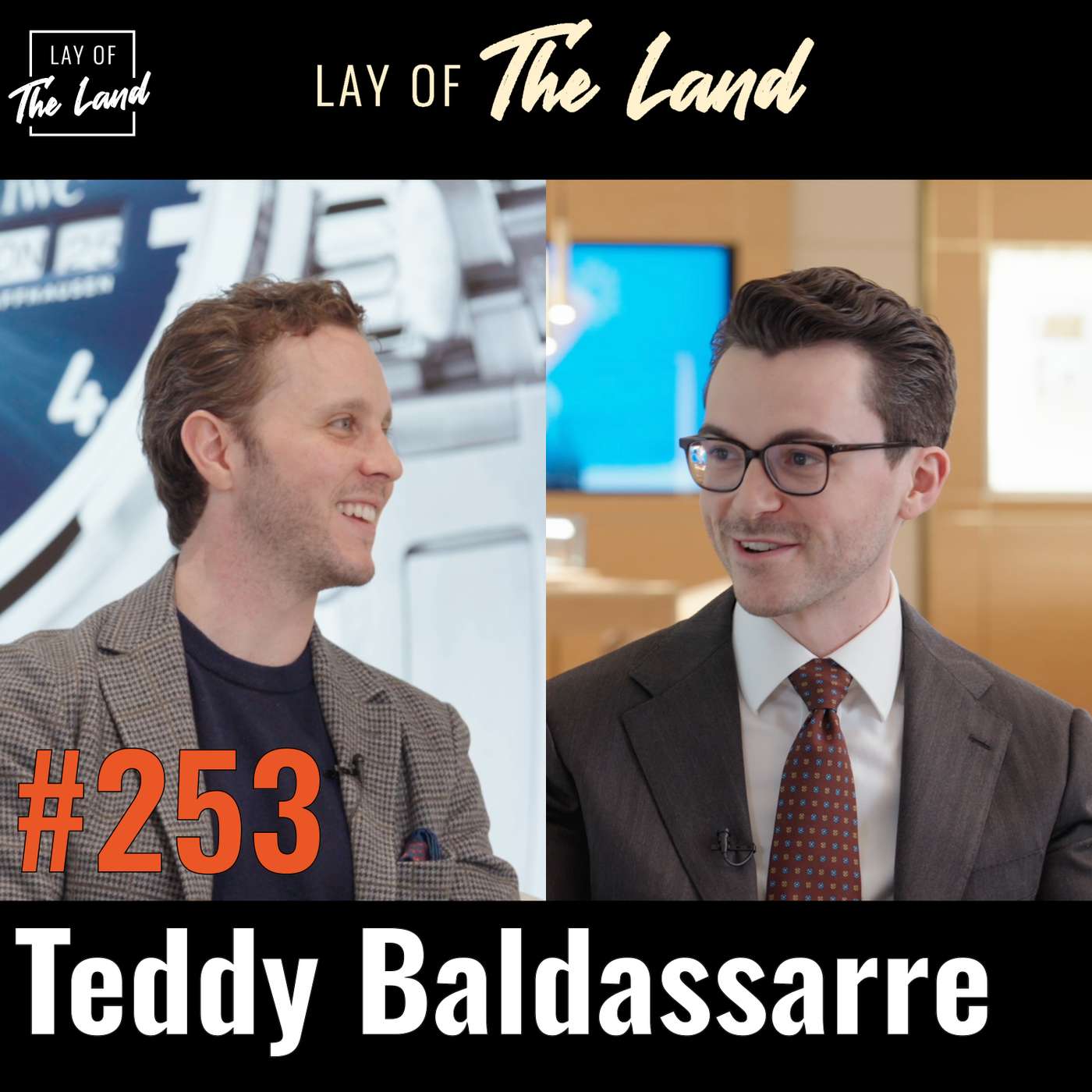
#253 Teddy Baldassarre — How Teddy Baldassarre Built His Brand

 Apple Podcasts
 Spotify
 YouTube
 Castro
 RSS Feed
 Teddy Baldassarre has built one of the most influential watch platforms in the world — and just as compelling as the watches themselves is the entrepreneurial story behind it.
I first met Teddy almost ten years ago at StartMart in Terminal Tower, before any of this existed: before millions of followers, before the global audience, before the authorized retail partnerships, and before the beautiful physical boutique we recorded this conversation in at Crocker Park.
In this episode, Teddy and I explore where his passion for watches began, how a first YouTube video evolved into one of the largest educational platforms in the watch world, and how he turned content into trust, trust into community, and community into a real business.
We talk about entrepreneurship, self-expression, building online credibility, navigating the leap from digital media to commerce and physical retail, working with traditional watch brands, the enduring appeal of mechanical watches in an age where no one technically needs one, and what watches can teach us about craft, memory, status, meaning, and time itself.
At its core, this is a conversation about building something that is an honest extension of who you are — and what can happen when curiosity, taste, discipline, and timing compound over the course of a decade.
00:00 Introduction & Meeting Teddy
01:00 Early Days: Startups, YouTube Beginnings
03:00 Discovering a Passion for Watches
06:00 Watches as Craft & Self-Expression
08:00 Turning Passion into Business & Monetization
11:00 Launching E-Commerce & the Pandemic Pivot
13:00 Brand, Community, and Content
16:00 Building an Approachable Watch Platform
18:00 Opening the First Store & Physical Expansion
20:00 Partnering with Legacy Watch Brands
22:00 Storytelling, Heritage, and the Value of Watches
25:00 Watches in Modern Culture & Technology
28:00 Entrepreneurial Learnings & Scaling a Personal Brand
32:00 Team Building and Company Culture
34:00 Pride, Impact, and Alignment with Life’s Work
36:00 Building Trust Online
38:00 Defining Success
39:00 Personal Curiosity & The Future of Watchmaking
41:00 Looking Ahead: Growth, Retail, and Community
42:00 Why Cleveland? Building Local Roots
45:00 Reflections on the Journey
46:00 Cleveland Hidden Gems & City Pride
49:00 Outro & Closing Remarks
-----
LINKS:
https://www.youtube.com/teddybaldassarre
https://teddybaldassarre.com/
https://www.linkedin.com/in/teddy-baldassarre-70795890/
-----
Stay up to date by signing up for Lay of The Land's weekly newsletter — sign up here: https://layoftheland.ck.page/5f0c1e28fa
Connect with Jeffrey Stern on LinkedIn — https://www.linkedin.com/in/jeffreypstern/
Follow Lay of The Land on X @podlayoftheland
--
Stay up to date on all Cleveland Startup and Entrepreneurship stories by signing up for Lay of The Land's weekly newsletter — sign up here.
00:00 - Tempo: 120.0
Jeffrey Stern [00:00:05]:
Welcome to the Lay of the Land podcast where we are exploring what people are building in Cleveland and throughout Northeast Ohio. I am your host, Jeffrey Stern, and today had the real pleasure of speaking with Teddy Balbasar. Teddy has built one of the most influential watch platforms in the world and it was a lot of fun to sit down with him today. What is particularly fun about this conversation is Teddy and I met in Start Mart in Tower City in Cleveland and 10 years ago, before any of this had existed. And so in our conversation we get to explore where his passion for watches stem from, what it takes to build a platform of that scale and influence, what drives him today, and a whole lot more. Teddy has found a business that is an actual reflection of who he is as a person. He has found his life's work and it was genuinely amazing to hear him reflect on the whole journey so far. So please enjoy this wonderful conversation with Teddy.
Jeffrey Stern [00:00:58]:
So let's take us back to 2016. This is the moment that we got to meet each other. We are in Terminal Tower, Tower City. It's also the year that I moved to Cleveland. At a time when you had a normal job, you were employed at a startup here in Cleveland, the co founders of whom have both been on the podcast and express actually a real pride that you quit their company at a point where you had achieved about 10k subscribers and took the entrepreneurial leap yourself. And I thought it'd be fun to ground the conversation that we're about to have in kind of revisiting that time period. Because I think if you had told me back then that today, 10 years later, we'd be sitting here in this beautiful space that you built with a world renowned platform for watches, with millions of subscribers across social media and YouTube and a growing physical presence. I would have respected the ambition of the vision.
Jeffrey Stern [00:02:02]:
I would have been rooting for you. But you know, it's. It's a reach, it's something aspirational. And had you conceived something like this or.
Teddy Baldassarre [00:02:13]:
Absolutely not. I mean, I've always mentioned how like, this is all almost like an accident. It's just been day by day. There was no grand vision, the only at that time. And I guess I could give more of a sense of what was going on in my life. So I was working at a higher education technology company. I really liked just the concept of like entrepreneurship. So when I was in college, I was very involved with our entrepreneurship program.
Teddy Baldassarre [00:02:35]:
I know you're a Venture for America fellow. I knew Venture for America. I was actually going through the application process of that I didn't end up getting in, but I love just entrepreneurship and the concept of building things. Yeah. So I landed and think you did as well in like the entrepreneurship and startup community here in Cleveland. And at the time, I didn't have really intention of growing something for myself, but I wanted to be around founders. But I tasked myself in like 2016, 2017. It was more of just this feeling because I was a young guy that I just wanted to express myself in the interest that I had.
Teddy Baldassarre [00:03:09]:
And I didn't have really any place to do it other than thinking like, all right, let's just post a video on the Internet. Because I always liked video production. Yep. And I was still working in business development at Weiser at the time and I was really enjoying it. I loved working with John, Kate, Chris. They're fantastic people to go to battle with. But with uploading that video, it was almost just a surprise. I didn't tell my friends, I didn't tell my family I was going to do it.
Teddy Baldassarre [00:03:34]:
And people watched it. I got a little lucky too. And all I've really done is just continued to double down every single day. And there was no grand vision. I didn't have a business plan. I didn't think anything was going to come from it. It was just an aspect of me. I liked this subject and I wanted to just share it as a point of self expression.
Teddy Baldassarre [00:03:52]:
But I think just this interest in like building things, corresponding with right time, right moment, have just led to all of this, which is still pretty crazy. I mean, like, I don't actually ponder this. And you were part of like the origin of like where this was starting to begin. If you would have saw me like walking around doing my product demos with all these different institutions, you would have
Jeffrey Stern [00:04:10]:
seen a washroom in our dingy co working space.
Teddy Baldassarre [00:04:12]:
Yeah.
Jeffrey Stern [00:04:12]:
Well, one of the things I remember from that time, my grandmother has this saying, you know, dress for the part that you want. And you were always, you know, well put together.
Teddy Baldassarre [00:04:19]:
Oh, thank you.
Jeffrey Stern [00:04:20]:
No, but honestly, like. But it was clearly something you cared about. And I like this idea of self expression. I've heard a life's work described as a lifelong quest to build something for others. That's an expression of who you are.
Teddy Baldassarre [00:04:33]:
Yeah.
Jeffrey Stern [00:04:33]:
And I mean, it feels like you have found it.
Teddy Baldassarre [00:04:37]:
I like to lean on luck a lot. I think timing and just doing it at that moment, at that time was the right gut feeling. I don't know if the whole follow your passion thing is like the right advice. I think I just got Very lucky. But I also think that it was just fortunate timing and I maybe have a knack for communicating about this subject that is just not fabricated in any way. Like, I really love this.
Jeffrey Stern [00:04:59]:
It's authentic, it's genuine. Where does that come from?
Teddy Baldassarre [00:05:02]:
It was a similar time to my interest in entrepreneurship. I was thinking about my life after school and I always liked had an interest in like fashion, but mostly style. Like I always liked heritage clothing, like finely made things. And I saw watches as mostly first when I was on the outside, because I have no family connection to watches at all. I don't have any crazy family heirlooms. Like, that's not something my parents had an interest in. But I just discovered watches first as an accessory. And I'm like, okay, this is a cool thing.
Teddy Baldassarre [00:05:29]:
You're a man, you're a professional, you wear a watch. So let me just see what this is all about. And then I started to get into the subject and I was so caught off guard because I'm just a very curious guy. I'd say I'm kind of like an autodidact. I like to self teach and just learn as much as I can. And this was a subject where I could just sink my teeth in. And I felt like I could just keep discovering more. Like I was just thinking it is a deep rabbit hole.
Teddy Baldassarre [00:05:55]:
And if anybody's collected watches, they understand what I'm talking about. And if you've never like recognized that this is like a whole industry, this will really catch you off guard. The design aspect, the mechanical engineering aspect, the just whole point of self expression and all these ways that you can wear a watch. And we live in a very disposable world too. And you have this weird, just small little industry that's not thinking about the broader concept of what is needed. It's just simply doing what has been done. And it's almost like an artistic pursuit. And I found a real fascination with that.
Teddy Baldassarre [00:06:30]:
Something that gets better with age. It lasts. Everything that we have in our lives, for the most part, wears out. Watches, they get better as you wear them, they become an expression of you. So that was all fascinating to me. So I just became just totally taken over and almost obsessed around the subject.
Jeffrey Stern [00:06:48]:
Yeah. Which is often what entrepreneurship requires.
Teddy Baldassarre [00:06:51]:
Yeah, true. I didn't connect the two at the time. I was just like, all right, I like entrepreneurship. I liked working with founders. I like building things. I like solving problems. And then I also collected watches in college. When I discovered them, I didn't have the funds for it.
Teddy Baldassarre [00:07:05]:
So I Had to, like, delay it. So then once I got that first job, I'm like, all right, I'm buying this. I'm buying this. John and Kate hope they don't get mad. But there was one time I was like on a lunch break. I'm just like, oh, you know, let me get this. Yeah. So there was a lot of that obsessive thought process that during that time.
Jeffrey Stern [00:07:19]:
At what point do you begin to think that this passion can lead to a sustainable and entrepreneurial undertaking?
Teddy Baldassarre [00:07:28]:
It took years, actually.
Jeffrey Stern [00:07:30]:
Yeah.
Teddy Baldassarre [00:07:30]:
Because it's a. I've been able to reach a lot of people, thankfully, but it's a niche space. Like, watches are not, like, mainstream for many people. And if you are just simply trying to build a business model on just posting videos on the Internet, chances are you have to be in a larger space, number one, you have to be appealing to a broader scope of a subject or you have to monetize very heavily with, like, advertising in stream. And still it's. It's a. It's a chase and like a burnout in a lot of ways for. For people.
Teddy Baldassarre [00:08:02]:
Because you have to always feed the engine. Always feed the engine. Always feed the engine for what YouTube and these social platforms are looking for. So it really wasn't until probably 2019, 2020, and really 2020, when this actually felt like it could be something that could work.
Jeffrey Stern [00:08:18]:
Yeah. What was the signal that you got? What was resonant about what you were putting out there? What gave you the confidence?
Teddy Baldassarre [00:08:25]:
Well, the content was always interesting. I think people were following it. The content, the fact that people were watching was always intriguing, but given it was a small niche space, it really didn't have a monetization model that I thought that was sustainable. I could just go act like a madman like I was and just post a bunch of videos all day, but I would burn out. So really the tipping point was figuring out what's the best way to monetize. And I had to do that because this is how, at least I think if you can fall into a place where you really like what you do, I see it as an obligation to try to preserve that for as long as possible. So I'm going to double down. I have to seize this opportunity because it's like my duty.
Teddy Baldassarre [00:09:06]:
I've been able to be given this opportunity to push forward. I have to figure out how I can sustain that. And to me, it was figuring out what is the lifestyle, what is the way that you could build something that could actually do that. Because if it was just Me just grinding it out for 20 years and just posting everything, editing everything. That's not sustainable for me. So I needed to figure something out. So I went back and forth on what could potentially work. We had leather goods that we were selling, like straps, but that wasn't very scalable.
Teddy Baldassarre [00:09:33]:
You can't really do much with that. I had a website, probably in 2018, 2019, we launched that. Then there was the whole concept of, wait, maybe you sell placement to brands, you make content for brands. But I hated that idea because the whole reason why I started this was because I liked the subject. I didn't want to get jaded and have brands dictating my voice and what I wanted to cover when. So the ultimate arrival to what eventually worked. It didn't work at first was representing the brands, becoming an authorized dealer. Now, this idea came in 2019, and most of the brands had a very old school way of looking at how watches were sold.
Teddy Baldassarre [00:10:12]:
It's not done on the Internet online
Jeffrey Stern [00:10:14]:
with no passion about it.
Teddy Baldassarre [00:10:15]:
Yeah. And I was a young face. I had barely any gray hair. I mean, it's just like, okay, this is weird. I don't want to. Like, these are Swiss institutions, European institutions, Japanese institutions, and some of them are older than the country that I'm residing in right now. So change in new things. They're rightfully cautious, and I totally respect that.
Teddy Baldassarre [00:10:35]:
They had to make sure that felt right. Well, an opportune time was Covid as bad as it was for many of us, it was for at least my opportunity to grow the business, actually a fortunate time to launch an e commerce site. So most of the brands said no. We proceeded forward. There's a small cohort of brands started building a website in late 2019, and we're getting it done. And it was a stressful time for me too, because I didn't know if any of this was gonna work. I wasn't really making any money. I had an editor and somebody was shooting the B roll of the watches and kind of like doing customer service hybrid with the straps.
Teddy Baldassarre [00:11:10]:
And I was not taking a salary. I was just putting all the money into building the website. And then as I'm having all this reluctance and thinking like, okay, is this gonna work? 2020 March happens, of course. And I'm like, oh, no, this is.
Jeffrey Stern [00:11:25]:
I remember that.
Teddy Baldassarre [00:11:26]:
Yeah, this is not good. And I'm really stressed at this time because we're like in the middle of the site. I'm not taking a salary. There's like lockdowns going on. But it ended up being a pretty great time to launch e commerce site in hindsight. So June 2020, we launched the site, and where I started to think, like, wait, there might be something here to answer your question was when we started selling some watches, it wasn't a lot at the beginning, but, like, wait, but someone watches. I got a Shopify, like, notification. Someone just bought a watch.
Jeffrey Stern [00:11:55]:
Yeah.
Teddy Baldassarre [00:11:56]:
And that's from a. Whoa. This is. That's cool. This is really cool. This is now where it makes sense. And I could see the scale of it. So it was just then going back to some of the brands after you had a proof of concept, and just one by one, because it was locked down.
Teddy Baldassarre [00:12:09]:
Some of these brands are essentially out of business because you couldn't have a physical store that was open. There was more openness to exploring different avenues, and we started to perform well and watches were selling. I think we maintained trust with our audience, which is a huge aspect of this too. I've always allowed people to recognize where my interests lie, and there's never a perfect way, but that's been my way of navigating this and actually building a scalable business. So that was that moment in 2020 where it's like, wow, someone bought a watch.
Jeffrey Stern [00:12:38]:
Yeah.
Teddy Baldassarre [00:12:39]:
Yeah, that was it.
Jeffrey Stern [00:12:39]:
That's exciting.
Teddy Baldassarre [00:12:40]:
Yeah.
Jeffrey Stern [00:12:40]:
I mean, a lot of threads to pull in there. The way I might frame it and help reorient me if this is not right. But I feel like, as an outsider observing, there's sort of the content, the community and the commerce aspect of Teddy. And I think there's a lot of interesting areas to explore there. I mean, one of which is trust. Like, how do you balance your authenticity versus your selling stuff?
Teddy Baldassarre [00:13:07]:
Absolutely.
Jeffrey Stern [00:13:08]:
So we'd love to unpack that, but just maybe to start. Is that how you think about Teddy? Like, what are the aspects of the business? How do you kind of organize it in your head?
Teddy Baldassarre [00:13:18]:
You know, I don't always think about it in that manner. It's funny because how this became a personal brand was just me simply having a YouTube channel. And it basically means you had a Google account, and it was in my name. So I didn't have this, like, grandiose vision of, like, I'm gonna build a personal brand. I just had a YouTube channel that was my name, and. And I posted a video on it, and it got views, and then it started to get some traction. And then ultimately it's like, all right, do I want to change the name? Well, probably not. Like, I'm going to call it, like, TikTok.
Teddy Baldassarre [00:13:50]:
Time or something, you know, like, it's just, like. It just didn't make sense. I was keeping my name. So I guess the premise for me and how I think about it is I don't even think I'm building a brand. It's just, like, almost like an extension of me. Like, the whole idea around why I started this was just to be able to have a platform where I could talk about something I'm passionate about. And the business side of it is just a way and an avenue for me to preserve that and bring people along in that journey. Because I felt like an outsider here in Cleveland to talk about watches.
Teddy Baldassarre [00:14:15]:
Like, when I first posted it, part of the reason why I didn't want to tell my friends and my family is like, I thought it was kind of, like, I was a little embarrassed by it. Like, the fact that I was into this because you don't go on the street and someone's, like, talking about your watch. That's, like, not normal. But I was the type of guy that would do that. So I'm like, am I crazy? So I just posted it, just kind of hoping that I could reach people and just making watches something I could talk about. And thankfully, I was just met with other people like me.
Jeffrey Stern [00:14:42]:
That is one of the real beautiful things about the Internet.
Teddy Baldassarre [00:14:45]:
Yeah, for sure. Good and bad. Sometimes it can perpetuate different.
Jeffrey Stern [00:14:49]:
What's the likelihood that people in your geographic proximity are gonna also have the same interests and all that, but online, it's like. I mean, there's a lot of people out there.
Teddy Baldassarre [00:14:56]:
Yeah. As long as it's a healthy thing that you're pursuing, I think it's a great. Yeah, absolutely.
Jeffrey Stern [00:15:02]:
Yeah. So how would you describe what. What Teddy is.
Teddy Baldassarre [00:15:07]:
What I want this brand to be is. It's an approachable brand, because I don't want this to be what I felt when I was getting into watches, which felt like a little stuffy. It was a. It was a world.
Jeffrey Stern [00:15:20]:
It's intimidating.
Teddy Baldassarre [00:15:20]:
It's. Intimidating is a great word to describe it, because I. I did not go into a watch store. Like, I didn't go into watch stores. Cause I'm like, do I wear a suit? What do I do? Like, I want to have this be a place where people can explore a passion that I think is very unique in today's world. We live in a disposable world where everything just doesn't last. And you have this cool, artistic form of an object that's, like, the first thing you put on every day. And the last thing you take off.
Teddy Baldassarre [00:15:45]:
It's a pretty intimate connection. Yes. Is it needed? No, it's not. But at the same time, it does represent something pretty unique, I think, the world that we live in today. So I want to create an inviting place where people can learn about this. I want to be representative of our industry in doing that.
Jeffrey Stern [00:16:02]:
Right.
Teddy Baldassarre [00:16:03]:
And then also be a trusted place where somebody can learn about this and then also buy a watch. So it's really just creating this ecosystem of education and trust around the whole pursuit of watches. Like, that's really what I'd like to create.
Jeffrey Stern [00:16:16]:
Yeah. So we are here in a physical space right now that is the evolution of a lot of things having gone well in that journey. When did you begin to piece together this is something that you might want to add on?
Teddy Baldassarre [00:16:31]:
Yeah, it was probably around 22, 23. Started to think about it on a couple points. One was that there's a sense of, like, a little bit of pride. That could be kind of cool, like, just have a store. But there had to also be a business case, too. And I think when I was analyzing this is the really interesting part about going from, you know, digital to going more traditional brick and mortar is, you know, where your customers are. So you could see and start to do some math of, like, all right, if you opened a store, how many people in that market might be open and available and already engaging with you? So that was some of the analysis you could do. And then the other aspect was events, being able to have people come in and what that could bring, and then just allowing the brand because it's all about this, like, approachable aspect and people feeling like there's a personal connection.
Teddy Baldassarre [00:17:23]:
Well, if you don't have a actual physical presence to uphold that, then I feel like that's a missing link. And then I think the last thing, too, is just there were certain brands that were a little slow to think about, like, proceeding forward on an E Commerce basis. So all of those factored into the decision in 2024, and it started before that because it does take a lot of time for these things to come to fruition. But in February 2024, we opened our first store. It was right down the road in Crocker, and it ended up being probably outside of posting the bet of the video. First video, the launching of the E commerce site. The third best decision was opening that store. Like, those are the big three moments, and they're probably the three biggest risks I took.
Teddy Baldassarre [00:18:04]:
Right. One was, like, just expressing myself freely. Maybe you could say quitting my job was also a big risk, which it was. And that was definitely a big step. The site and then opening that store.
Jeffrey Stern [00:18:16]:
Yeah. You mentioned the institutions represented here, the legacy, the history. What does it take to partner with them and what's the actual business economics of how this all works?
Teddy Baldassarre [00:18:38]:
Yeah. So at first, when you're doing the e commerce route, we were able to develop some relationships with some of the brands because as you look broadly at this industry, you'll recognize that most of it's in a group structure. So for some of the brands in here, we would work with brands online first and then it would ultimately lead into the brick and mortar. But a lot of it is just asking, asking, asking and just presenting a business case of, hey, this is our site, this is what we're doing, this is what we're all about. This is why we think we're a good fit. I have a passion for the brand and also a lot of it too comes down to fit like the brands in the store. All ones that I hand selected.
Jeffrey Stern [00:19:15]:
Yeah.
Teddy Baldassarre [00:19:16]:
So that's a, that's a fun aspect, but a lot of it is just pretty traditional stuff. You're reaching out, you're making a business case. But these brands are, they're very protective and I take that very seriously. Like these, they've been around for hundreds of years, some of these brands, and they're going to be very thoughtful about who they partner with. So you just have to have the right balance of like the look for like the environment both in store but also online.
Jeffrey Stern [00:19:42]:
Yeah.
Teddy Baldassarre [00:19:42]:
And they have to feel comfortable. But the good news too for us was we were able to just have pretty good success and had some good case studies digitally. And it's just one by one, it was just like, all right, here's what's going on with this is what we've been doing really well. And it's just over time you just would continue to get more brands. And how brands really think about is they, they want an environment. Nobody wants to be first. Right. No one wants to be first.
Teddy Baldassarre [00:20:04]:
So you do have to strategically think about like bringing in like almost a cohort where everybody feels comfortable because it's all about co tendency and making sure that you're in an environment that everybody feels like it. It does make sense for them and it's a strong position for their brand too.
Jeffrey Stern [00:20:19]:
Yeah. When you think about the whole market for, for watches, what. What do you feel most people don't understand about it? You meant, you know, because obviously it is like a niche thing.
Teddy Baldassarre [00:20:32]:
Yeah.
Jeffrey Stern [00:20:32]:
Not a lot of People are every day thinking about it as much as you are. From your perspective, what do you see as the unique parts of this industry from a business standpoint, what do you wish more people understood about the business side of it?
Teddy Baldassarre [00:20:45]:
Business side? Well, I think to appreciate the business, you also have to understand the product itself. I think the biggest gap is that if I take this off my wrist right now and I could talk about, this is the Speedmaster. This is a watch that part of the Apollo program, you can storytell that mechanically. This is all being powered by a spring. I wind this. There's a spring inside that is coiling up in a barrel, and that is what's allowing this complete release of energy. There's no battery inside of here. This is all just a process that's been developed hundreds of years ago and can still wear it today.
Teddy Baldassarre [00:21:18]:
So part of it is just the education of knowing what this industry represents and how different that is compared to any other. Other than that, I mostly don't even really try to position the business side of this industry. I don't really talk about it much. It's more just storytelling. Why this is cool?
Jeffrey Stern [00:21:35]:
Well, it is storytelling. One of the things I was thinking about, really, in preparation for this conversation, I was thinking about watches. And it's like, well, they went from this. It's kind of a function, form, framing of it. But they went from a device that was about optimizing for precision, trying to solve a problem. And basically, Quartz made the cost of precision negligible.
Teddy Baldassarre [00:21:59]:
That's right.
Jeffrey Stern [00:22:00]:
And so it becomes about storytelling, brand taste, status, like all these things
Teddy Baldassarre [00:22:08]:
in
Jeffrey Stern [00:22:08]:
the evolution of the watch from something that solved a problem to this is something that tells a story about who you are. Like, how do you think about the storytelling part of it? When someone comes in here, ultimately they're maybe gonna buy something. But it is more than that.
Teddy Baldassarre [00:22:28]:
Well, first you have to acknowledge the absurdity just to meet in the middle, because at the same time, none of this is needed. I think that's an important point. Getting somebody on your side, right?
Jeffrey Stern [00:22:38]:
We have an iPhone.
Teddy Baldassarre [00:22:39]:
You don't need it.
Jeffrey Stern [00:22:39]:
Tel's pretty good time.
Teddy Baldassarre [00:22:40]:
And if you acknowledge that first, now you have the foundation to actually talk about why this is cool. Because it's not about that. People say, I got my time right here. Well, that's not why you do this. And there's certain aspects of why someone might like watchmaking. There are certain people that like the aspect of status. There are people that like that. That's not really what I speak To I speak to mostly just that point of self expression, talking about the design elements and like how you can have this small little vehicle.
Teddy Baldassarre [00:23:11]:
It's like this vessel of being able to express in a way it's very unique. It is fun to think about design on a product like this. Cause you can think about different material, you can think about contrast, you can think about typeface, you can think about the historical elements and why this was originally designed as a piece of kit, as a tool and how that progresses over time and being able to speak about that. And especially for a lot of like, you know, men and even women too, like there aren't many objects that can transcend us. And when you come, when you. I'm not someone that's very materialistic and I know that might sound crazy, but I always try to keep this balance of you can come in here and buy a watch and you can spend money on a lot of different things. But in my, my view, like if you are going to spend money on this, this object means nothing until you actually experience it. And I like objects when you can actually experience them.
Teddy Baldassarre [00:24:08]:
Like if it's in your home and you have a beautiful chair you could pass down to your kids and every crease is an element of you and maybe an evening with a nice book and being able to express that these are these type of objects that can actually do that. And you're wearing an heirloom piece.
Jeffrey Stern [00:24:23]:
Yes. I think about my grandfather every time I see it.
Teddy Baldassarre [00:24:26]:
I don't know how many things in life actually can represent that. But also have a sense of utility, a sense of design. And also you can pass. Pass that down where that is now part of your story.
Jeffrey Stern [00:24:37]:
Yeah.
Teddy Baldassarre [00:24:37]:
And I think that's pretty powerful.
Jeffrey Stern [00:24:38]:
It is, yeah. You're a good salesperson. So on the, on the. Some of just like the watch in society topics, what's your take on daylight savings?
Teddy Baldassarre [00:24:53]:
That's funny. Personally, I don't like daylight savings, so I'm not a fan of it. I actually don't keep all my watches wound all the time too. So it doesn't throw me off in that regard. And sometimes I don't even have some of my watches set legitimately. So it doesn't throw me off in that way.
Jeffrey Stern [00:25:08]:
When you wear them.
Teddy Baldassarre [00:25:09]:
When I wear them sometimes, yeah.
Jeffrey Stern [00:25:10]:
Why is that?
Teddy Baldassarre [00:25:12]:
Maybe just quickly out the door and it's more of just like, okay. But I just feel like it's a sense of me in this and like I want to like present that in a way. Most days this is correct. I promise. Yeah, yeah. There's just maybe 10% of the time like, oh, crap.
Jeffrey Stern [00:25:24]:
Right. One of the other kind of societal topics. You alluded to it earlier, but I mean, with AI, there's a lot of slop out there and the content is endless and there's sort of a visceral human, I feel like aversion to a lot of it. And I think the flip side of that is a renewed interest, care, interest for craft. Are you seeing that? Are you seeing.
Teddy Baldassarre [00:25:59]:
Yeah, absolutely. I mean, it's the antithesis of the world and direction that we're headed in many ways. And if you look at like a lot of the guys in, like, San Francisco and like some of the leaders in tech, what's been really funny is seeing some of them get this fascination and bug in watches at the same time. Like Mark Zuckerberg, like, this guy has gone on this frenzy of acquiring watches, and this is a guy who runs Meta. And. And what is, what is his connection? Why would he be interested in this? But it kind of shows that there is like this fascination. Even people on the cutting edge of tech and seeing where the world is going still has this weird draw to something that's more like just rudimentary in like, it's at least performance in a modern day. Right.
Teddy Baldassarre [00:26:43]:
Yeah.
Jeffrey Stern [00:26:44]:
The last kind of watches in society idea was at one point they were just meant to keep the time. And you mentioned, you know, we don't even really need them anymore, but in some ways we've kind of become beholden to clocks. We. We've kind of transitioned away from the biological, natural rhythm of things to a society where, I mean, without them, I don't think society works, frankly.
Teddy Baldassarre [00:27:08]:
Yeah.
Jeffrey Stern [00:27:10]:
And just if you've thought about that, I'm more like waxing philosophical.
Teddy Baldassarre [00:27:14]:
Yeah. Well, there's also an element of watches. As much as sometimes I don't always care about this being right to the second, there is a sense of utility that is very nice about them. And maybe to answer your question too is like, okay, what are the things that I find the most important? And someone asked me a question recently like, okay, what are the things in your life that you would want to protect the most and at the top of your family and things of that that are important to you, the people, is time. Right. I mean, like, that's like, if I had to protect something, that is it. And if this can be a little reminder of that, of what's important. And that's pretty powerful.
Teddy Baldassarre [00:27:51]:
Well said.
Jeffrey Stern [00:27:51]:
Well said. So I'm sure a lot of Learnings along the. Along the way here.
Teddy Baldassarre [00:27:57]:
Oh, yeah.
Jeffrey Stern [00:27:57]:
A lot of, you know, it always just looks a little good and rosy from the outside. What comes to mind as some of the most salient entrepreneurial learnings you've had in this. In this journey?
Teddy Baldassarre [00:28:11]:
Well, one for me especially is because this is a personal brand.
Jeffrey Stern [00:28:15]:
Yeah.
Teddy Baldassarre [00:28:16]:
There was a lot of learning in just being able to take a step back. I think a lot of. A lot of times when you're assessing as an entrepreneur, you recognize because you've done every task in this business. Like, I've pretty much everything that's being done right now. At some point, that was my job. And I think a tough thing to do, especially in a personal brand, because my name's on the building.
Jeffrey Stern [00:28:35]:
Yeah.
Teddy Baldassarre [00:28:36]:
You have to really exercise this practice of letting go. And how I assess it is if there's somebody that can come in with even 80 to 90% of effectiveness to what I could do, you should let that go. And you should really figure out, where are you? Not nobody can replace you or it's harder to replace. That's where you need to be looking towards at all moments. And for me, it's always looking ahead of, like, what's the vision of the company? It's the content side. It's some of the strategy. It's like brand relationships. Like, those are the points that are the most important for me.
Teddy Baldassarre [00:29:07]:
So that was massive for me to figure out in the early days, because you find that you're effective and you could do all these jobs really well, but that's actually not the right measuring stick. It's not whether you can do it well, it's whether somebody else can do it well, too. And if the answer is yes, you have to quickly remove yourself. And sometimes it's even things that you might like. It might be things that you even enjoy. And that's like, the hard thing because I see a lot of business owners. How do you let go of that? And that's a sense of self and reflection that you have to have. And I definitely had it many times in this business because my name's on the building.
Teddy Baldassarre [00:29:41]:
And it's like you feel a personal connection to the entity itself, probably more than even some other entrepreneurs would. But I know that's a big challenge for many leaders in business, but something I had to learn myself. Just pivoting, pivoting, like, a lot. I mean, I would rather own my mistake and make a jackass of myself today rather than let society or my customers pin the tail. Right. I don't Want to go down a route, it's okay if you pivot quickly, because a lot of times you think, this is the right route, this is the right route to go. And then on a dime, the next day you're like, wait, that's not right. So you should always be second guessing yourself a little bit in a thoughtful way.
Teddy Baldassarre [00:30:22]:
You should believe in your vision. But when you're growing, it's. It's not like a Fortune 500 company where, here's our plan for the year, here's our budget, here's what we're gonna do for our quarterly earnings call. That's not the play for as you're growing, you have to really be adapting quickly, and it's better for you to own up to a mistake that you think is coming. Even if you made this big proclamation like, this is our direction, it's okay, just pivot. And there's certain people that don't like that in your organization, and you also have to recognize that too. And speaking of people, I think one thing I've learned a lot in the last four years as we started to grow the team is just how you work with hire people. Something that I've learned with hiring people is it took some learning.
Teddy Baldassarre [00:31:08]:
It's actually having compassion even during the hiring process. What I think about when I'm looking to hire somebody now is always, okay, treat them as if they're an employee today. Why I say that is partially because I think you think like, oh, you hear these policies like slow to hire, quick to fire type of ideas. I think that's a little bit of an oversight because if you hire somebody, there's a personal element to it and then there's also just the aspect of. It always takes longer to separate from a relationship than you always, you know, you think there's baggage attached and then there's a human element to it as well. So, like, I think that's something that I've learned too. Compensation is like constitutional document, and you shouldn't change it unless it's absolutely necessary or think about it very far ahead. That's something I've also learned.
Teddy Baldassarre [00:31:56]:
So there's just been a lot. There's been a lot of learnings, but those are just some that just come to mind.
Jeffrey Stern [00:32:00]:
Yeah, I'll pull on the team thread. I mean, one of the things, I mean, walking in here this morning before you arrived is, I mean, you have an amazing team, and a lot goes into setting this up every day. From cleaning the floors, pulling out all the watches, just getting it ready. Obviously, the brand is an extension of yourself, but you have people, a whole team that's helping you kind of realize it on a daily basis. How do you think about the. Who is part of the extension of yourself and what the culture looks like, what you think about from that perspective?
Teddy Baldassarre [00:32:38]:
Yeah, what's been really fun too is the people that watch have become people that work here. So that's always helps too. Like you can actually like people that watch the actual content. Like if they are.
Jeffrey Stern [00:32:47]:
It's a recruiting mechanism.
Teddy Baldassarre [00:32:49]:
It can be. So there's a lot of people that work for the company that, that was actually the case. But in terms of culture, like it has to. You have to have an interest in the subject. Like you can't not like you can be a great on paper, like, you know, great Ivy Ivy League school. And this is my background, this is what I run. But if you don't understand the industry and you don't have a passion for it, it's probably not going to work. But you also have to have a good balance too, where this is still a business too, and you have to be able to not be so just consumed in the subject and also see what's best on that side.
Teddy Baldassarre [00:33:19]:
And I think you have to have that balance. But I think the most important thing though for me is just someone that also represents the values that I have. And the cool thing is with all the content that we've done, it's almost just been this time capsule of showing self. And I think people on the outside can get a better sense of like the brand that we're trying to build because there's so much of these personal little documents through video that exists. So you basically have been able to carve like your ethos and idea around what the business is very quickly. And I think you just have to get a sense that people that are aligned on that same wavelength.
Jeffrey Stern [00:33:55]:
What are you most proud of?
Teddy Baldassarre [00:34:02]:
I actually really. It's two things. One is the fact that when I can see someone in person and I've been recognized, it's not like a fame thing, but it's just the fact that what the person says, it's like, you got me into this. The fact that as a guy that when I started I felt isolated, I felt like maybe I'm a little weird. Nobody else is into this. But then people come up and like the fact that you had like influence in any way and like an impact and providing some sense of joy to somebody, like, that's sweet, it's cool. It's really cool. And like, this is their, like, interest, and you're helping them in, like, discovering a part of them and, like, their own, like, discovery of what makes them happy.
Teddy Baldassarre [00:34:48]:
Like, that to me is like, number one. And I mean, number two is just to be able to. I mentioned earlier, like, time and like, freedom. Like, like, why I pursued like this and why I was excited beyond just expressing myself was just also, like, I can do something that I love every single day, and I've been able to build a team that helps in exercising that vision. I mean, that. That's very rare. Like, every single day I go by, like, I see how cool this business is. And it, like, it's one thing to have a business, but the other aspect that I just love about this is, like, it's in alignment.
Teddy Baldassarre [00:35:22]:
Right. You know, I built something that's in alignment with me, and I see a lot of people that are successful and more successful than me, but I feel like I'm in the right seat in the right place. And that's been a really rewarding thing.
Jeffrey Stern [00:35:35]:
I think it hearkens to the idea of a life's work. Like, you have found it. You have found the thing that feels like play that other people think is valuable.
Teddy Baldassarre [00:35:44]:
Yeah.
Jeffrey Stern [00:35:45]:
What have you learned about building trust online?
Teddy Baldassarre [00:35:48]:
Hmm. Yeah. Part of it is luck again. You know, I think the fact that it's a personal brand helps, but I think that also allows me to keep myself always in check. Because when you're online and you feel like a disassociation from the people that are watching, like, I try to always connect with that association. Like, when I look into the lens, like, one of the best, like, aspects of just, like, judging what is actually taking place was looking at the lens and thinking about the true connection of viewership. Like, when I look at the lens, I am not just speaking to a lens. I am speaking to people.
Teddy Baldassarre [00:36:25]:
And sometimes that is.
Jeffrey Stern [00:36:27]:
And you're visualizing that.
Teddy Baldassarre [00:36:28]:
I'm visualizing it. I'm speaking to a stadium right now. And what would I say to those people? I don't think people recognize that connection of. I am speaking. Yes. To this digital platform. But the end viewer, it's a person, as a person. And I think that's the first step is recognizing who you're speaking to, what you're representing, and upholding that is like a duty.
Teddy Baldassarre [00:36:51]:
That's a duty. So that's step one, two is that you can jeopardize it at any moment, and you should not be thinking short term about anything that you're saying or doing.
Jeffrey Stern [00:37:01]:
Yeah. Built in drops lost in buckets.
Teddy Baldassarre [00:37:04]:
Yes, exactly. Think long term. There's no short term opportunity that's worth a reputation loss. Absolutely not. So you always maintain that. And I think you also have to be honest about where your interests lie. When someone watches me, they recognize that I do sell watches. I get it.
Teddy Baldassarre [00:37:24]:
I could see people. There's gonna be certain people are not gonna like my style. And I get it. I saw it, I had to do it because it's an opportunity for me to talk about something that I love on a day to day basis and allows me to build a business in something that I love. So I will pick the best way to do that. And the other thing that I always keep in mind is that for people that are watching is my name's on the building. And if I jeopardize my business, I jeopardize myself. And that keeps me in check too.
Jeffrey Stern [00:37:51]:
Yeah, that is a good check.
Teddy Baldassarre [00:37:53]:
Yeah, it is a good check. Can't build a new name unless I create a new alias. But that's not what I want to do. I like what we built.
Jeffrey Stern [00:38:01]:
How do you think about success?
Teddy Baldassarre [00:38:05]:
We talked a little earlier about like, what would you protect? Right. Yeah, you know, it's success is for me, it's protecting the things that I care about. Yeah. It's like, okay, it's freedom. It's freedom of time. It's being able to pursue my interests with like some financial flexibility. It's being able to do work that you actually enjoy and doing it maybe more on your own means when you want to do it, your own schedule, like that flexibility, like that's success for me. And then also just a sense of like self actualization.
Teddy Baldassarre [00:38:36]:
Right. And I feel very self actualized in what I do on a day to day basis and being able to share that passion with others, share the upsides of it with the people I love. I would say that's like my sense of success. And it's always building, it's always evolving like success. Every single season it changes.
Jeffrey Stern [00:38:51]:
Yeah. So you've gone about as deep down the watch rabbit hole as probably anyone out there. What do you find your curiosity is pulling you towards now that you have an actual understanding of how all this works? The actual, you know, pieces themselves, the industry. Like, what do you, what do you find yourself being pulled towards right now from a curiosity standpoint?
Teddy Baldassarre [00:39:12]:
As a personal collector?
Jeffrey Stern [00:39:14]:
Sure.
Teddy Baldassarre [00:39:15]:
As a personal collector, I'm getting more into like independent watchmaking. So like the very small batch, like creation of like these watches where like there's Almost like it's like preposterous to even have a business around them. Like these guys that are just like making watches with no other reason other than just the fact that this is what they love to do. Yeah, I find a lot of purity in that. So I definitely interested in that.
Jeffrey Stern [00:39:40]:
I think that's the future in some ways too.
Teddy Baldassarre [00:39:41]:
Yeah, there's a lot of interest in that too. Like right now, like the independent scene I think is really. I'm really interested in it. The other thing that I've been pursuing from like an artistic identity sense is just being able to co design watches with certain brands. So that's been fun for me because I've been able to take all of the perspective of reviewing watches, talking with collectors, and you have this data set in your brain that when you can work with a brand, allows you to express a vision.
Jeffrey Stern [00:40:12]:
Have you always felt that creative impulse within you from like a design and aesthetic? I think so, yeah.
Teddy Baldassarre [00:40:19]:
Yeah, I've always been attracted to that. I did consider starting my own brand at one point. I just. I'm not going to do it because it's a whole nother business, it's a whole job, it's a whole commitment. But if I can check in some little expressionary points where I can do that in my own way and do it in a way that works within the ecosystem that I've created, like, absolutely.
Jeffrey Stern [00:40:42]:
So again, we're here in this beautiful store. It took a lot to get here. I think we covered a decent amount of that journey. What are you excited about looking forward from here?
Teddy Baldassarre [00:40:53]:
A lot of things. A lot of things. Growing a team, continuing to grow a team. I get excited when we add new people and we can tackle new problems. That's number one, doing more. Because this is all new. This is two months old. So I'm just excited to have events here, have more people that have followed us, experience this space.
Teddy Baldassarre [00:41:12]:
That's something that when we opened up the first store, like it was, we were talking before camera, like just being able to see someone that I was able to connect with digitally and then see them in person for the first time, like, that was surreal.
Jeffrey Stern [00:41:23]:
Yeah.
Teddy Baldassarre [00:41:23]:
So to have more of those interactions because people come up and they're just excited and they, you know, built this relationship with the brand and being able to actually have a physical meeting space where we can do that is great. I'm excited to, you know, maybe see where retail goes after this. Because we opened one store in 2024. We opened, did an expansion two years. So clearly this Whole store thing, it's working and we really like doing it. I didn't have any idea around retail before doing this the last few years, but it's been fun. It's been fun. So I'm excited to just continue to maybe pursue that if opportunities present themselves
Jeffrey Stern [00:42:01]:
on the Cleveland thread. One thing that people always talk about with real estate, it's like location, location, location. I mean, if one of your fears at the beginning was are there enough people in this proximate area that care about watches, how did you think about like why, why are you here? Beyond this is where you're from and, and you know, maybe a commitment to that, but just there's probably a lot that goes in that decision.
Teddy Baldassarre [00:42:22]:
Well, one thing that for this industry happens is a lot of the brands, they invest heavily into certain pockets of the country more than others. And if it's a market like Cleveland, which is not like a New York, it's not a Miami, it's not an la, it's not a Vegas, it takes somebody to jump in and raise their hand like, hey, I want to build something here. And then that's where the brands will usually be more open to it. And I see a huge opportunity in like a market like Cleveland because the reason I felt isolated at the beginning was because I felt there wasn't something that I would go to when I was into it.
Jeffrey Stern [00:42:58]:
And I created the space that you wish existed.
Teddy Baldassarre [00:43:00]:
Yeah, exactly. And I created the content. Now the content is exactly that too. I want to create content that is representative of what I would want if I was getting into it. So same thing with the retail space. So that was part of the decision making process for just coming to Cleveland and Crocker specifically. This was an area that from a foot traffic standpoint, like very strong, very strong here. It's also on the side of the city where I think there's a lot of growth, there's more development that's going to be happening here on the west side of town.
Teddy Baldassarre [00:43:30]:
You have to think about the trade areas, where are other maybe potential retailers. So you have to position yourself in that manner. But then we also have a destination buyer. So we're close to a highway exit, we are close to the airport. We have a lot of customers that come in from out of town. So that was part of the thought process too. And you could also look digitally at where people are at. And if you can do the, the math and the numbers of who's already engaging, that also helps in making sure you feel more confident in your decision.
Teddy Baldassarre [00:43:57]:
Y And people were here. We have a team here.
Speaker C [00:43:59]:
Right.
Teddy Baldassarre [00:43:59]:
That helps you, right?
Jeffrey Stern [00:44:00]:
No, it certainly helps.
Teddy Baldassarre [00:44:01]:
And you know the market. Yeah.
Jeffrey Stern [00:44:03]:
I imagine it's pretty cool to have built this in, in your home. Yeah.
Teddy Baldassarre [00:44:06]:
A lot of pride. I, I, I love saying I'm from Cleveland. I do. Really do.
Jeffrey Stern [00:44:10]:
So, yeah, I'm sure there's, there's a lot here that, that we didn't cover. Is there something that feels particularly important when you do this kind of reflection on the journey that, that you wish we had?
Teddy Baldassarre [00:44:25]:
You know, we were talking too. Like, this has become, like, almost like a little bit of a therapy session. Yeah, it's been great. It's been, I feel like you've been able to unearth a lot of, like, what I've wanted to express. And, like, if I just talked about these subjects without somebody asking them, it might come off a little pretentious. But you've been able to give me the avenue to talk about this. But I feel very fortunate to do what I do.
Jeffrey Stern [00:44:44]:
Yeah.
Teddy Baldassarre [00:44:45]:
I want to continue to uphold my duty of. Because I've been, I've been gifted an ability to talk about something that I love, and I see that as my side of the bargain to uphold to the people that have given me that voice. Because I'm. In the early days, I brought this up in the, maybe like an interview for it, but I remember when I was assessing YouTube, it gives you this tool where it will see, like, your audience retention. And based off of what you say at a certain moment, you might see a drop off. In the early days, when I would say words like I, people would actually drop off. So part of my messaging was always just to provide value to people and be and bring brevity to the conversation, to give them what they need in a short period of time. But now what's happened is because I've given people what they've wanted, now what I get the request of the most, the things that do the best, is when I talk about myself and my collecting.
Teddy Baldassarre [00:45:29]:
So, like, I've been given. It's funny, that works. You give to others and then they ultimately want to give to you. And that's what, that's how I feel like my whole position, my ability to have a voice that's like a big reflection point for me, and I'm just very appreciative of it.
Jeffrey Stern [00:45:42]:
Yeah. Beautifully said.
Teddy Baldassarre [00:45:43]:
Thank you.
Jeffrey Stern [00:45:44]:
Well, I think we can work to bookend it here with our traditional closing questions.
Teddy Baldassarre [00:45:49]:
Let's hear it.
Jeffrey Stern [00:45:50]:
Hidden gems in Cleveland.
Teddy Baldassarre [00:45:53]:
I love Cleveland. Yeah. I like to explore A lot. I'd say a few. One would be. So this is a new. This is a new spot. It's in Cleveland Heights.
Teddy Baldassarre [00:46:01]:
It's called Moyo. So it's on Cedar Fairmount, and it's a amazing store. It's one of the best, most curated, best curated stores I've seen, and I've gotten to go to different stores all across the globe, and they've done a phenomenal job. So it's like a menswear, womenswear spot. But then they also do, like, these really interesting, like, vintage found goods. So, like decorative items. It's like a mix of, like, an interior design shop with like, a clover. So that would be one Moyo.
Teddy Baldassarre [00:46:28]:
Moyo. Mo I O. So it's like brand new. You probably have never heard of it. So that's.
Jeffrey Stern [00:46:33]:
I haven't.
Teddy Baldassarre [00:46:34]:
That's awesome. Yeah. Yeah. That'd be one of my hidden gems. Cuffs and Sugar and Falls, I think is one of the best shops in the country for finely made clothing. They're the last independently owned Hermes retailer in the world. On top of it, they're in an old historic building in chagrin. It's amazing.
Teddy Baldassarre [00:46:53]:
I love a lot of different food spots in town. I wouldn't say you've had Doug Katz on. I love all of his spots like Kiln, Zug and Amba.
Jeffrey Stern [00:47:00]:
Really good.
Teddy Baldassarre [00:47:00]:
Yeah, they're all fantastic. Vero Pizza, which is right next to Moyo, probably my favorite pizza shop in town. I can keep going. I love all these different spots.
Jeffrey Stern [00:47:09]:
What do you wish more people knew about Cleveland?
Teddy Baldassarre [00:47:12]:
What I always tell people is I talk about the history of this city. And at the turn of the 20th century, this was like the 5th, 6th most populated city in the country. And the underbelly of the arts and the commerce that happened during that period of like the Gilded Age going into this more like the 20th century and all the industrial progress that was made in the city. I mean, you had the richest man that ever lived was in from Cleveland, Ohio, and a lot of the infrastructure on the arts, like our art museum is world class. Our orchestra is world class. Playhouse Square is world class. Like, you have these investments into these institutions here. That is very unique and it's a great place to live.
Teddy Baldassarre [00:47:54]:
I like the different pockets of places that you can live in this city. It's an underestimated city. You have major sports teams. The food is great, the culture is great. I think there's a lot to like about Cleveland. I agree. I've been to 20 different countries. I understand my bias to Cleveland.
Teddy Baldassarre [00:48:10]:
But at the same time, if you actually explore and see what the city has to offer, I think there's a lot to love and I'm happy to play my role a very small way and trying to help push that vision forward, but I want to see it continue to succeed.
Jeffrey Stern [00:48:21]:
Yeah. Well, this is awesome. I'm very grateful that you took the time to have a therapy session.
Teddy Baldassarre [00:48:26]:
Yeah.
Jeffrey Stern [00:48:27]:
If you will. But I really enjoyed it.
Teddy Baldassarre [00:48:29]:
It's been fun for me too, because, like, we knew each other before any of this started. Yeah. No, it was cool to have like that joint perspective and being able to
Jeffrey Stern [00:48:38]:
get to look what you can build in 10 years.
Teddy Baldassarre [00:48:40]:
Yeah, it really is. It's about 10 years.
Jeffrey Stern [00:48:42]:
It's amazing.
Teddy Baldassarre [00:48:43]:
Yeah.
Jeffrey Stern [00:48:43]:
Well, thank you, sir.
Teddy Baldassarre [00:48:44]:
Appreciate it, brother.
Jeffrey Stern [00:48:44]:
I'm really excited for you. If folks had anything that wanted to follow up, learn more about, come visit.
Teddy Baldassarre [00:48:50]:
Yeah, Teddy Balasar on all social channels. That's about it. I mean, you'll find me. And if you look up, Teddy, watch.
Jeffrey Stern [00:48:55]:
Easy to find.
Teddy Baldassarre [00:48:56]:
Yeah, you'll find me.
Jeffrey Stern [00:48:57]:
Cool. Well, thank you.
Teddy Baldassarre [00:48:58]:
Of course.
Speaker C [00:49:00]:
That's all for this week. Thank you for listening. We'd love to hear your thoughts on today's show, so if you have any feedback, please send over an email to jeffreyoftheland fm or find us on Twitter odleoftheland or @sternfa j e f E. If you or someone you know would make a good guest for our show, please reach out as well and let us know. And if you enjoy the podcast, please subscribe and leave a review on itunes or on your preferred podcast player. Your support goes a long way to
Jeffrey Stern [00:49:29]:
help us spread the word and continue
Speaker C [00:49:31]:
to bring the Cleveland founders and builders
Jeffrey Stern [00:49:33]:
we love having on the show.
Speaker C [00:49:34]:
We'll be back here next week at the same time to map more of the land. The Lay of the Land podcast was developed in collaboration with the UpCompany LLC at the time of this recording. Unless otherwise indicated, we do not own equity or other financial interests in the company which appear on this show. All opinions expressed by podcast participants are solely their own and do not reflect the opinions of any entity which implies employs us. This podcast is for informational purposes only and should not be relied upon as a basis for investment decisions. Thank you for listening and we'll talk
Teddy Baldassarre [00:50:06]:
to you next week.